-
-
Downtown
Wolhwa Street
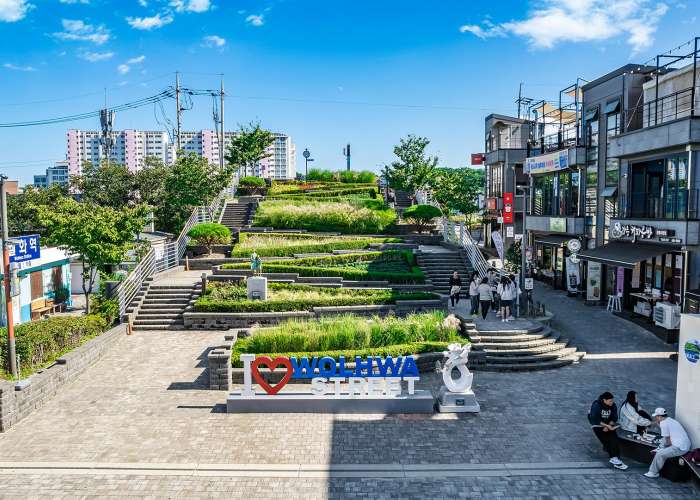
Wolhwa Street is an urban park created along a former railway line in downtown Gangneung.
Introduction
Wolhwa Street is an urban park created along a former railway line in downtown Gangneung. The name “Wolhwa” comes from the poignant local legend of Muwollang and Lady Yeonhwa, a love story that inspired Korea’s famous classic “Chunhyangjeon.” With a rich narrative and inviting atmosphere, this charming street is a place everyone wants to walk, filled with delicious food, performances, and exhibitions.
Tourist guide
Wolhwa Street stretches 2.6 kilometers from Gangneung Station to Buhung Village, transformed into a themed linear park. At its entrance is “Mal Nanumteo Park,” followed by “Imdang Square,” also known as the Folk Market. Further along, the Historical and Cultural Plaza sits beside Homeplus, and the area near Jungang and Seongnam Markets is known as the Living Culture Plaza. Each section offers a unique experience that reflects the daily life, history, and traditions of Gangneung.
Tourist Tips
The name "Wolhwa" originates from a local Gangneung folktale—the heartbreaking love story of Muwollang, a descendant of King Taejong Muyeol of Silla, and Lady Yeonhwa. According to the tale, a pavilion once stood on a rock cliff near Yeonhwa Peak along the Namdaecheon River. It was named Wolhwajeong (Moon-Flower Pavilion), combining characters from their names: “Wol” (moon) from Muwollang and “Hwa” (flower) from Lady Yeonhwa.Although the original pavilion was swept away by a great flood in 1936, a marker stands on the original site, and a reconstructed version can be visited today.As you walk along the 2.6km Wolhwa Street, you'll encounter themed areas such as parks, plazas, and cultural spaces—perfect for exploring Gangneung’s past and present while enjoying scenic walks, tasty bites, and local arts.
#폐철도길#음식#무월랑#전시#거리공원#연화부인
-
-
Jumunjin Area
Jumunjin Fish Market
A conventional market that is popular for squid fishing at the Jumunjin port
Introduction
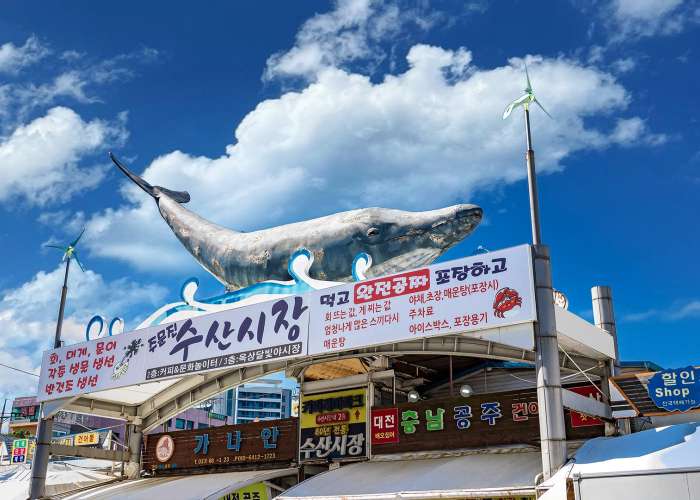
Jumunjin Fish Market in Gangneung, Gangwon Province is famous for squid-fishing at the Jumunjin port which is a traditional market that has been established since 1936. Land area is 4,291㎡ * business floor space is 5,761㎡ * store floor space is 2,316㎡ * and includes a total of 70 stores. The Jumunjin Fish Market is a comprehensive market that includes a dried fish market, and sashimi center, etc. which provides a variety of stores that is known to be the largest fish market on the East coast including more domestic and overseas tourists.
Tourist guide
On the East Coast, including freshly caught squid, mackerel, pollack, saury, and crab you can treat yourself with a variety of fresh seafood at a lower retail price. You can feel the atmosphere of the East Sea where you can taste the fresh fish. At the Jumunjin fish market and Jumunjin roadside in front is a whale sculpture and also many dried fish stores lined up. Inside the Jumunjin fish market is a fresh fish store and sashimi center where you can comfortably enjoy your fish and some spicy soup, dried squid or pollack, dried filefish, salted fish, etc. which are popular shopping items. It is the largest fish market in Gangwon-do that provides a variety of fish markets with markets such as traditional fish markets, dried fish markets, etc. where many tourists come and visit.
Tourist Tips
Nearby Attractions: Jumunjin port, Risabu Cruise, Jumunjin Lighthouse
-
-
Downtown
Jungang Market
A traditional conventional market located at the center of Yeongdong that sells a variety of products during the Gangneung Dano Festival
Introduction
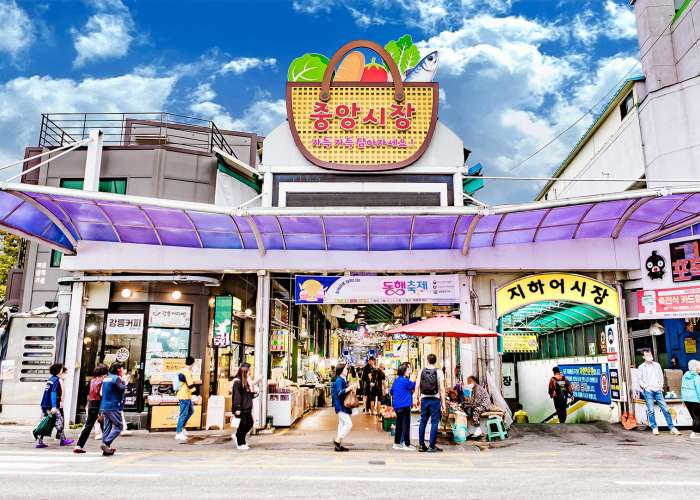
The Gangneung Central Market located at Geumgseong-ro, Gangneung-si represents the region's traditional market. Even before the time of Japanese Imperialism, it has been a permanently established market which is the main trading center for fish and crops in the Yeongdong region. The registered Central Market is a modern building with floors from Basement 1 to the second floor. Yet, citizens of Gangneung refers shopping areas close to the market as the Gangneung Central Market.
Tourist guide
According to the Central Market Cooperative, even during the Japanese Imperialism where the Dano was difficult to open, this central market was still the permanently established market during the time. For that reason, on ritual ceremonies President Mungwan Jo invites the cooperative president. He reveals pride that the "Gangneung Central Market was not only a historical and cultural market in the Yeongdong area, but also to distribution in the Pyeongchang area". The current Central Market building has been built in 1978 where it was registered as the 'Central Market Cooperative'. Even though there are only a total of 314 stores that are officially registered, if we combine the stores nearby, there are a total of 520 stores in this area. The stores on the streets near the central market have been registered as Seongnam Market.
Tourist Tips
The current building is the Central Market Built in 1978, was registered as a 'mid-market beonyounghoe. Officially registered 314 stores in the mall, but both combined 520 stalls until the store has to neighbor. Around the stalls surrounding the building, while the rain shelter facility four years ago, was registered in the name of Seongnam market.
-
-
Downtown
Dongbu Market
A mid-sized market housed in a commercial building, established in 1977
Introduction
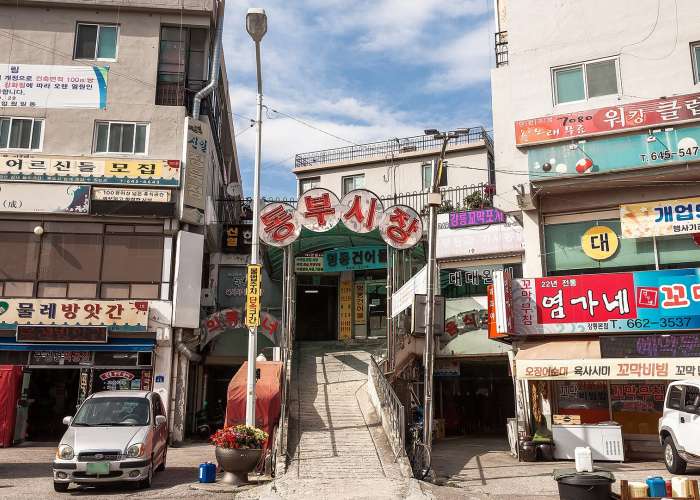
Gangneung Dongbu Market is a mid-sized market housed in a commercial building, established in 1977. Its main products include buckwheat pancakes (memil jeok / memil millstone pancakes), potato dumpling soup (gamja ongshimi), vegetables, and dried seafood. Most transactions conducted in Gangneung’s permanent markets are retail-based. Retail trading here is convenient thanks to easy transportation access and the wide variety of goods available.
Tourist Guide
Dongbu Market is a concrete building with 4 floors above ground and 1 basement level. The first floor houses general goods stores, supermarkets, small pubs, and restaurants. The second floor features shops focused on fish, vegetables, rice cakes, and edible oil production and sales. The third and fourth floors consist of 98 apartment units, many of which are inhabited by market merchants.
Travel Tips
For the convenience of visitors to Gangneung Dongbu Market, a free one-hour parking service is available. The parking lot is located at the Okcheon Parking Lot in front of the former Women’s Center. During holidays, when preparing traditional ceremonial foods can be stressful, Dongbu Market offers a wide variety of dishes such as ancestral rite foods, festive foods, side dishes, salted seafood, and kimchi—well-known for their excellent taste that feels just like homemade meals. With one hour of free parking and clean, trustworthy food options, Dongbu Market provides warmth and charm unique to traditional markets that cannot be experienced in large supermarkets. Beyond shopping, the market is home to many eateries. From potato ongshimi and kalguksu (hand-cut noodle soup) to a variety of traditional Gangwon dishes available only in local markets, visitors can enjoy satisfying meals while shopping. There are also many popular eateries known by word of mouth where you can enjoy delicious food at affordable prices.
-
-
Downtown
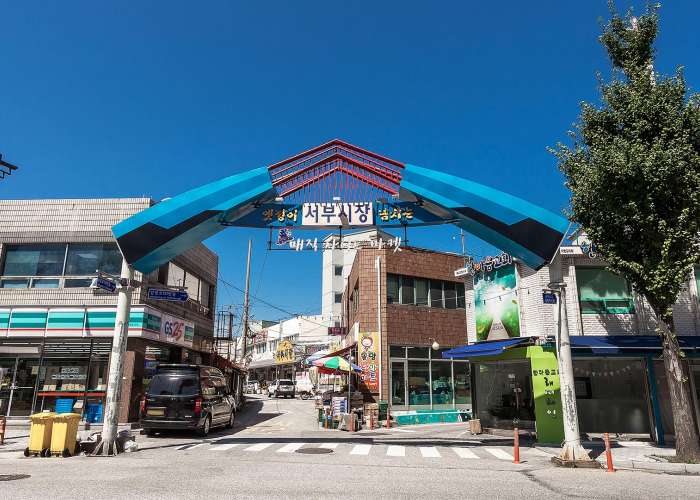
Seobu Market
A mid-sized market housed in a commercial building, established in 1977
Introduction
Seobu Market is a mid-sized commercial-style market established in 1977, located in Yonggang-dong, Gangneung-si, Gangwon State. In 1982, the old and deteriorated market building was demolished and redeveloped into a mixed-use complex where apartments and the market coexist. However, despite the concrete structure of the building, the internal facilities were not modernized, and business performance remained sluggish. To revitalize the traditional market, environmental improvement projects were carried out between 2004 and 2005.
Tourist Guide
The site covers an area of 3,707㎡, with one basement level and two above-ground floors. Construction included electrical, telecommunications, fire protection, gas, mechanical, and architectural work, and revitalization efforts continue under the leadership of the Seobu Market Merchants Association. The building is a reinforced concrete structure with one basement level and two floors above ground. The basement houses a wholesale computer market, while the first floor features clothing stores, oil shops, kitchenware stores, and food shops. The second floor accommodates offices for various clubs and organizations, forming a small local commercial district similar to other markets. The third and fourth floors are residential apartments occupied by merchants.
Travel Tips
Seobu Market in Gangneung, which has become a site for mural painting, is a permanent market established in 1977. Its long history is reflected in the traces of time visible throughout the market. Although it is not crowded, it is a quiet neighborhood centered around a small municipal library located within the market area. While many visitors to Gangneung often think of Seongnam Market or Jungang Market as the city’s traditional markets, there is another traditional market located close to downtown—Seobu Market.Seobu Market is a traditional market where tradition and modernity coexist, and it even features an electronics shopping area in the basement. The interior resembles an underground shopping arcade, yet compared to its spacious layout, there are relatively few shops. It gives the impression that specialization with unique characteristics is needed for the market to stand out. Unlike Jungang Market, Seobu Market does not receive heavy foot traffic, which leaves something to be desired. It is hoped that Seobu Market will also be revitalized into a lively traditional market bustling with visitors.On December 13, 2014, a mural painting project organized by “Youth Naru” took place in Seobu Market. This mural was part of the “Remember Sewol Ferry” project, involving participants ranging from elementary school students to working adults. As a result, several areas of the market have been transformed into vibrant streets. It is hoped that more murals reflecting the unique character of traditional markets will be added throughout the walls, helping revive the market under the slogan of a “traditional market + mural village” filled with Gangneung’s nostalgic charm.In addition to being a traditional market, Seobu Market also houses one of the 14 small libraries operated by the municipal library system—the “Cultural Small Library.” A unique feature of this library is its “Coffee Specialty Reading Room,” where visitors can learn about coffee and access related information. This makes it a distinctive library that reflects Gangneung’s identity as a city of coffee.Before entering Seobu Market, visitors will notice that nearby shop signs have been standardized into a unified font as part of Gangneung’s preparations for the 2018 Winter Olympics, creating a more orderly and visually pleasing street. It is hoped that the area surrounding Seobu Market will continue to develop into a unique, tree-lined street that preserves Gangneung’s traditional atmosphere.If you wish to see murals, you can visit Seobu Market in Gangneung at any time. The “Remember Sewol Ferry” mural project participants ranged from high school students to office workers, most of whom learned about the project through social media and voluntarily joined. As time passed, the Sewol Ferry tragedy was gradually fading from memory. Participants wanted to remember the victims and convey the message of remembrance through their actions. Some joined with the hope of keeping the memory alive longer. Despite freezing temperatures, they carefully completed each mural piece by piece, warming their hands as they worked.Much time has passed since the Sewol Ferry disaster on April 16. Seasons have changed, and people have returned to their daily lives. The media no longer discusses the tragedy, and it feels as though that day has somehow faded away. Nevertheless, the youth of Gangneung felt the need to speak about it again—to remind those who were tired of hearing about it that there are still people who have not returned, and that many injustices and disappointments following the disaster remain unresolved. They wanted to emphasize the importance of remembering.Four murals created by 14 young people convey the message, “Hope through memory alone.” It is sincerely hoped that these artworks will capture the attention of passersby, prompting them to recall and reflect upon the events of that April. As you walk through the alleys of Seobu Market, you can encounter these meaningful murals at any time.
-
-
Jumunjin Area
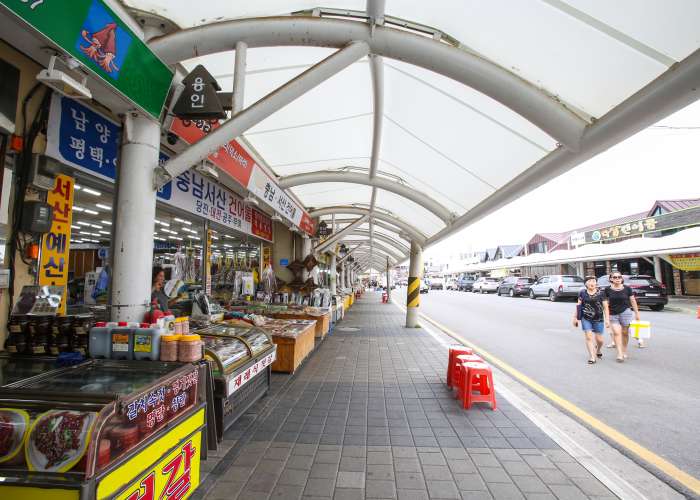
Jumunjin Dried Seafood Market
A wide variety of dried seafood such as squid, dried pollock strips, natural kelp, as well as fresh raw fish
Introduction
Jumunjin Dried Seafood Market is located in Jumunjin-ri, Jumunjin-eup, Gangneung-si. It was officially registered and opened on December 23, 2008, and currently operates as a registered market with 96 shops. The market consists of rows of dried seafood stores stretching along the coastal road and a raw fish center incorporated into the market district in 2014. It is a traditional tourist-oriented market connected with various nearby local commercial areas, including Jumunjin Fish Market and Jumunjin General Market.
Tourist Guide
In 2008, the market was selected for the “Pilot Project for Revitalizing Traditional Markets through Culture (Munjeonseongsi Project)” promoted by the Ministry of Culture, Sports and Tourism. As a result, efforts have been made to transform the market into a culturally enriched traditional marketplace. Key initiatives include developing the East Coast Fishermen’s Festival as a major event, turning representative seafood such as pufferfish and squid into tourism content, creating seasonal cultural festivals, and establishing an eco-museum featuring vivid storytelling of Jumunjin’s history. This ongoing transformation makes it a promising destination for the future.VR Map offering a 360-degree view of Jumunjin Dried Seafood Market: https://look360.kr/vr/jumunjin_market/jumunjin_market/25661
Travel Tips
Jumunjin Market is the largest fish market on the East Coast and a traditional tourist-oriented market with excellent accessibility due to convenient transportation. It is operated by the Jumunjin Fish Market Merchants Association, consisting of around 210 members, and the Jumunjin Raw Fish Restaurant Association. The market hosts various festivals such as the Pufferfish Festival and Squid Festival, offering plenty of attractions for visitors. It is also connected to diverse local commercial areas, including the five-day traditional market held on the 1st and 5th of each month, Jumunjin General Market, and the raw fish center, allowing visitors to enjoy both traditional and periodic markets. Located in the center of Jumunjin-eup, the market features wide access roads and excellent transportation, ensuring convenient access for visitors. Major items include squid, dried pollock strips, natural kelp, and various dried seafood and fresh raw fish.
-
-
Downtown
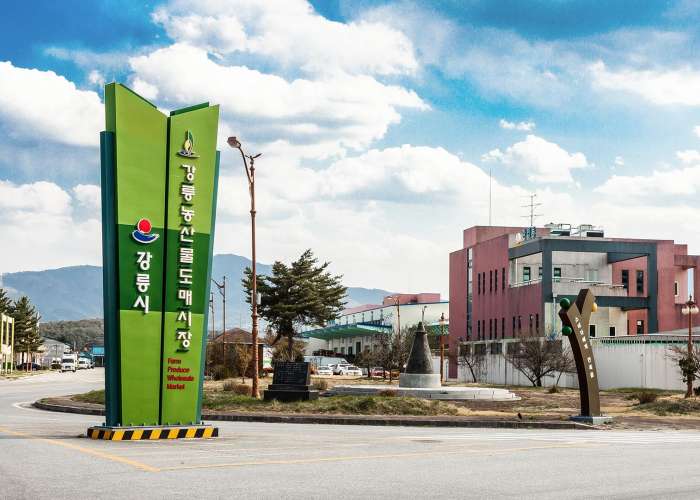
Gangneung Agricultural Wholesale Market
A wholesale market specializing in fruits and vegetables
Introduction
Gangneung Agricultural Wholesale Market Co., Ltd. opened in November 1999 and has grown into a key distribution hub for agricultural products in the Yeongdong region. Staff and distributors have continuously worked together to strengthen the market’s role. In response to increased imports under FTA agreements, the market supports local food distribution and contributes to the regional economy while fulfilling the responsibilities of a public wholesale market.
Tour Guide
The market promotes fair trade through open auction systems for all agricultural products, helping increase farmers’ income. It aims to grow together with farmers while providing reliable products to consumers. The site covers 65,825 pyeong, with buildings totaling 14,021 pyeong, and parking space for approximately 260 vehicles.
Travel Tips
To ensure food safety, the market conducts regular pesticide residue inspections: rapid tests twice a week (12 items) and detailed tests once a week (6 items). Any non-compliant products are fully discarded. Producers of such goods are banned from shipping to public wholesale markets nationwide for one month and may face legal action if violations continue. Detailed inspections are conducted in cooperation with the Gangneung Institute of Health & Environment.
#농산물#물류유통#공영도매시장#도매시장#보건환경연구원
-
-
Jumunjin Area
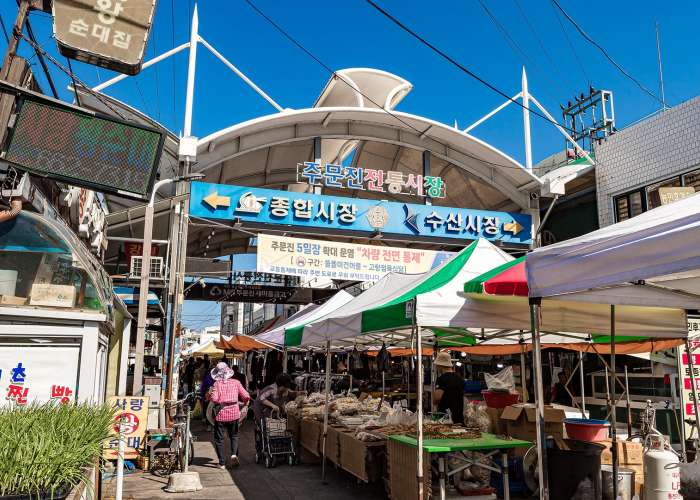
Jumunjin General Market
A small market in a mixed-use commercial-residential building established in 1950
Introduction
Jumunjin General Market is located in Jumunjin-eup, Gangneung, Gangwon Special Self-Governing Province. The market covers a site of 5,761㎡ and consists of around 70 stores offering a variety of goods including food, clothing, daily necessities, seafood, and local agricultural products.
Tour Guide
As a mixed-use market combining residential and commercial spaces, the interior is spacious and well-organized, making it convenient for both browsing and shopping. The warm hospitality of the merchants creates a welcoming atmosphere where visitors can enjoy their shopping experience with a smile.
Travel Tips
Jumunjin Market is a traditional market that began forming in 1936 near Jumunjin Port. It is one of the largest seafood markets on the east coast, specializing in fresh wild-caught seafood. The market is connected with various local commercial areas, including a five-day market (held on the 1st and 5th), the general market, and sashimi centers.While the Jumunjin Fish Market, established in 1988, is well known, the Jumunjin General Market, opened in 2006, is less widely recognized. In November 2009, an arcade roof was installed, and the market has since been modernized with upgraded electrical, communication, and facility systems.If you visit the fish market, you can easily find the general market nearby, where you will discover a wide range of products, attractions, and food options. In 2013, Jumunjin Market was ranked No.1 as a preferred traditional market destination by a national association supporting small business economies. Festivals such as the Blowfish Festival and Squid Festival are held annually.Visitors are also encouraged to use “Onnuri Gift Certificates,” which can be purchased at a discount and used conveniently in traditional markets. With diverse attractions and friendly service, this market is definitely worth a visit.
#주문진읍#농특산물#종합시장#재래시장#주문진항#수산시장
-
-
Jumunjin Area
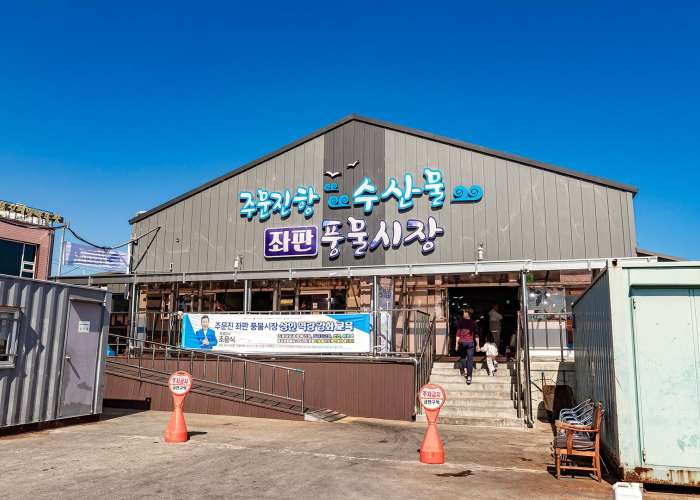
Jumunjin Boardwalk Traditional Market
A traditional market where you can enjoy seasonal seafood at reasonable prices
Introduction
Recognized as a traditional market on November 11, 2019, Jumunjin Boardwalk Traditional Market has a history of over 50 years. It houses more than 140 stores offering a wide range of local seafood, including live fish, processed fish, king crab, snow crab, dried fish, shellfish, octopus, and salted seafood products.
Tourist Guide
Jumunjin Port has long been a gathering point for fresh seafood from across Gangwon-do. Visitors can taste high-quality seasonal seafood from the East Coast, especially squid, at reasonable prices. Convenient transportation makes the market accessible to many tourists who come to experience its traditional charm and local specialties.
Tourist Tips
Nearby attractions include the BTS music video filming location, the drama filming site “Goblin” breakwater, Sodol Lighthouse, and Jumunjin Beach. Visitors can enjoy a rich variety of sightseeing experiences by exploring these scenic spots along with the market.
#전통시장#특산물#수산물#해산물#건어물#제철수산물#가족여행
-
-
Jumunjin Area
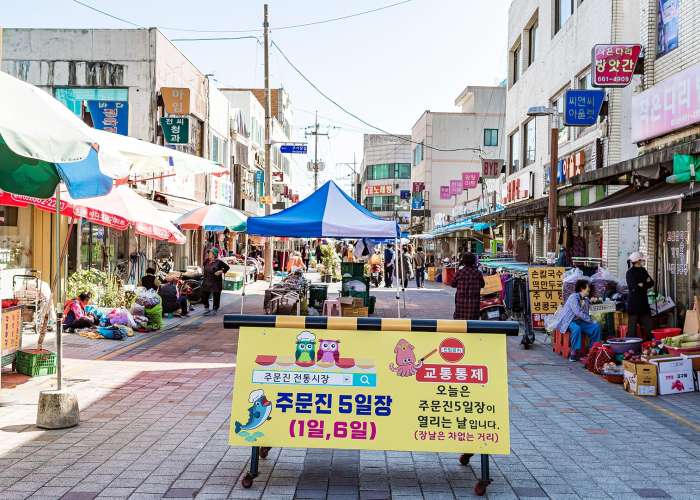
Jumunjin 5-Day Market
The largest traditional five-day market in Gangneung, established in 1936
Introduction
Jumunjin 5-Day Market, the largest traditional market in Gangneung, has been in operation since 1936. It is a place where representative local agricultural and seafood products are gathered, allowing visitors to experience the warm and nostalgic atmosphere of a traditional marketplace.As of November 16, 2023, the market has been expanded and is currently operating with around 60 stores.
Tourist Guide
Jumunjin 5-Day Market, once a major marketplace where people from nearby regions gathered, is expanding its operating area significantly to restore its former reputation. The surrounding streets have been transformed into a car-free zone, allowing visitors to enjoy the market more comfortably and up close.Visitors are encouraged to experience the charm of a traditional rural market, featuring local agricultural and seafood products as well as nostalgic snacks from the past.
Travel Tips
Through the Gangneung City (SEA TEA) Tour Bus, which connects Anmok Coffee Street, Gyeongpo Beach, Sacheon, Yeongok, Yeongjin, and Jumunjin Beach, visitors can conveniently explore not only Jumunjin’s attractions but also major tourist destinations across Gangneung in one trip. This makes it especially popular among tourists visiting Jumunjin.
#주문진#장터#5일장#주전부리#시골#농·수산물
-
-
Jeong Dong Jin, Okgye
Okgye 5-Day Market
A traditional Yeongdong regional market held on days ending in 4 and 9
Introduction
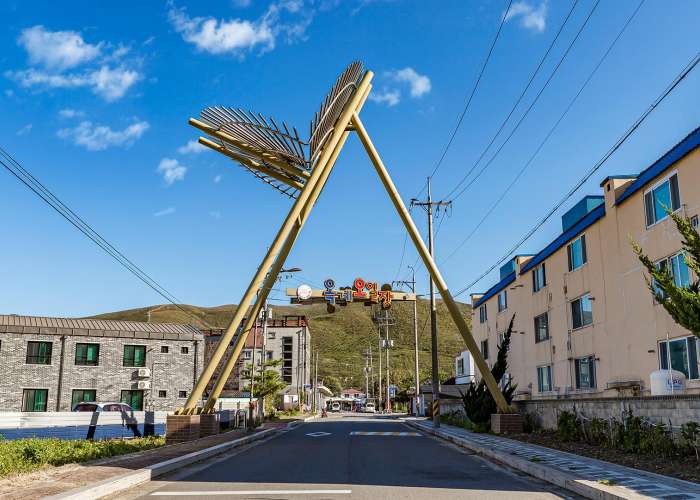
Traveling south from Gangneung, passing the lively Jeongdongjin and winding through mountain roads, you will arrive at Okgye-myeon. Here, a traditional five-day market takes place, offering a strong sense of rural charm. The market is held on days ending in 4 and 9, where visitors can find a wide variety of items such as grains, agricultural products, clothing, farming tools, and street food at affordable prices. It is a tourist market developed with support from Gangneung City to revitalize the local economy.
Tourist Guide
Driving south from Gangneung along National Route 7 will lead you to Okgye. As you pass the entrance, you will easily spot a prominent wooden signboard announcing the five-day market. At Okgye Market, as you browse and fill your hands with local goods, you will also feel your heart enriched by the warm hospitality of the countryside. Located just 30 minutes from Gangneung, it is easy to visit if you plan your trip according to the market dates. It is highly recommended to stop by this friendly market, where small groups gather and conversations bloom.
Travel Tips
Okgye Five-Day Market, held in Okgye—an area with a 2,000-year tradition linked to Okcheon—is held on the 4th and 9th of every month. The Bukpyeong Five-Day Market in Donghae is held on the 3rd and 8th, so travelers who enjoy exploring traditional markets may want to plan their itinerary accordingly. On market days, parking can be difficult due to the large number of visitors, but there is a riverside parking lot nearby that can accommodate hundreds of vehicles. Knowing this in advance will help you avoid the hassle of searching for parking.