Jeongdongjin & Okgye District
- Home
- Tour
- Nature Tour
- Jeongdongjin & Okgye District
-
-
Jeong Dong Jin, Okgye
Seokbyeongsan Mountain
A mountain spanning Imgye-myeon in Jeongseon-gun and Okgye-myeon in Gangneung-si, Gangwon Special Self-Governing Province
Introduction
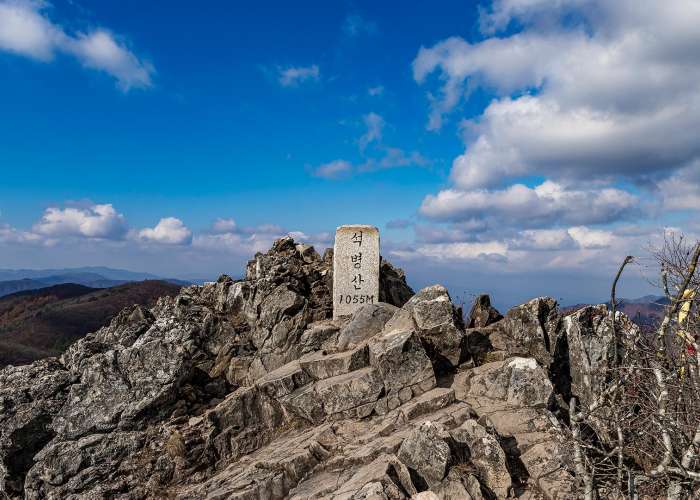
Seokbyeongsan Mountain is located on the boundary between Sanggyeri in Okgye-myeon, Gangneung-si, and Jigwon-ri in Imgye-myeon, Jeongseon-gun, Gangwon Special Self-Governing Province. It lies along the Taebaek Mountain Range. To the north of Seokbyeongsan is Duribong Peak, while to the south lie Jabyeongsan Mountain and Baekbokryeong Pass. The southern area of Seokbyeongsan features karst topography, with nearby attractions such as Seokhwa Cave, stone caves, and a cement quarry.
Tourist Guide
Seokbyeongsan Mountain, spanning Imgye-myeon in Jeongseon-gun and Okgye-myeon in Gangneung-si, boasts a height of 1,055 meters. The mountain is characterized by unique rock cliffs that resemble folding screens and its grand scale. Formed primarily of gypsum rock, it contains numerous caves, and although Beombawigol Valley is the main valley, no water flows through it. Additionally, when ascending along Jeongeori Valley, visitors will find a wide field and a spring where water emerges. The summit of Seokbyeongsan consists of two white rock peaks; the northern side forms a sheer cliff, and the rock ridge extends toward the northeast.
Travel Tips
The magnificent rock formations and natural scenery of Seokbyeongsan attract many visitors. For those who wish to hike the mountain using a relatively easy course, it is recommended to start from Baekbongnyeong Pass, pass through Seokbyeongsan, and continue to Sapdapnyeong Pass. At Baekbongnyeong and the ridge near Peak 834, there is space large enough to accommodate several large buses. However, Sapdangnyeong Pass can barely accommodate one large bus, so please plan your route carefully. Visitors can enjoy refreshing mountain breezes at Seokbyeongsan, and the summit is composed of three modest-sized rock peaks. Beneath the central peak is a rock cave that has been blocked with stones due to candles lit for ritual prayers. Throughout both the ascent and descent, hikers can enjoy beautiful wildflowers and azaleas. However, since the area is less frequented by hikers, extra caution is required during summer as you may need to pass through vine-covered areas and thorny vegetation. Also, if you continue heading north after reaching the triangulation point on Seokbyeongsan, you may deviate from the main ridge trail. Therefore, to reach Duribong Peak, you must return to the triangulation point and follow the signs heading west.
-
-
Jeong Dong Jin, Okgye
Deungmyeong Beach
A beach with a wide sandy shore and a dense pine forest
Introduction
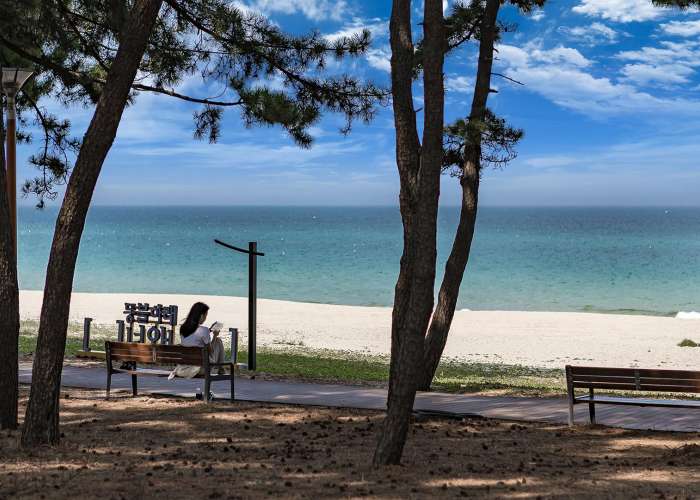
Deungmyeong Beach, located in the Jeongdongjin-ri area of Gangdong-myeon, features an 800-meter-long sandy shore covering 24,000㎡, along with a spacious parking lot and a lush pine forest. It is situated approximately 240 km southeast of Seoul, about 8 km south of Gangneung, 12 km from Donghae, and around 80 km from Sokcho. The beach is easily accessible as it is adjacent to the Yeongdong Railway Line, Donghae Expressway, and National Route No. 7.
Tourist Guide
Deungmyeong Beach is a well-equipped beach with generally good infrastructure. The walking paths and commercial areas are paved with blocks, and parking facilities are well maintained. Within a 2 km radius of the beach, visitors can find attractions such as the Korean War Memorial Monument, the five-story stone pagoda of Deungmyeongnakgasa Temple, and a carbonated mineral spring to the north. Broadcasting transmission towers for KBS and MBC, which relay signals across the Gangneung area, are also located nearby, offering panoramic views of Gangneung.
Travel Tips
Deungmyeong Beach lies along the walking route from Jeongdongjin to Haslla. If you have visited Haslla, you can reach the beach by walking a short distance toward Jeongdongjin. From Jeongdongjin, it is just one bus stop away. The Yeongdong Railway Line runs right next to the beach, with pine forests standing on both sides as if protecting the tracks. This beach is relatively small, and on one side, you can see barbed-wire fencing marking a military protection zone. The dense pine forest creates a scenic landscape. At night, the pine forest offers a cozy atmosphere, and the lights shining through the trees create a unique ambiance. Watching the sunrise over the sea here provides a sense of happiness and the awe of nature that is hard to experience elsewhere. Shower facilities are available for a fee, and inflatable tubes can be rented. The shower water is extremely cold, like icy water in midwinter. Restrooms located by the beach are very clean and well maintained. The commercial area and walking paths are paved, making them convenient to use. Exercise facilities are also available near the beach, making it a great place to enjoy light exercise after an early dinner.
-
-
Jeong Dong Jin, Okgye
Geumjin Beach
Drive along Heonhwa-ro and Relax at a Cozy Seaside
Introduction
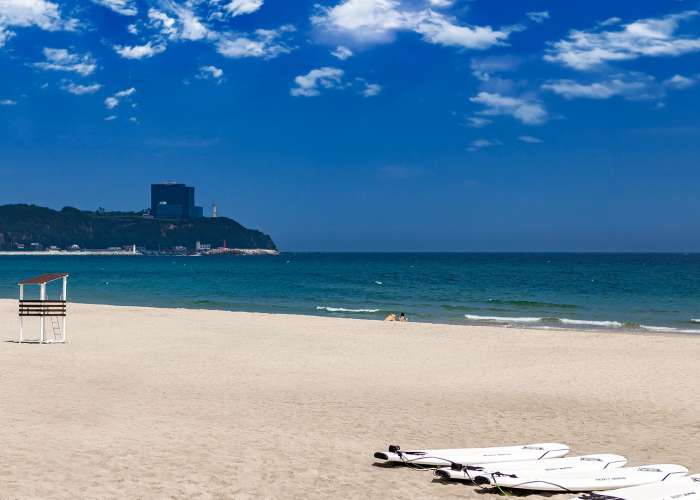
Located in Geumjin 1 and 2 villages of Ok-gye-myeon, this beach stretches 900 meters with a 63,000㎡ expanse of white sand. It is quieter and cozier than most beaches, and anyone who visits once often returns every year. Additionally, driving along Heonhwa-ro, the coastal road connecting Geumjin-ri and Simgok-ri, offers breathtaking scenic views.
Tourist Guide
On a small hill visible from Geumjin Beach lies Geumjin Hot Springs. The geothermal water, emerging from about 1,000 meters underground along the coastal terrace, contains calcium and magnesium in the golden ratio of 1.618:1. It is also rich in rare minerals such as selenium and vanadium, known for their healing properties. These unique components make Geumjin Hot Springs an exceptional resource, valuable even on a global scale. Recognized for its medical benefits, in 2009, the Ministry of Knowledge Economy designated it as a leading regional industry and local linkage project. Clinical research on 15 diseases is currently underway, demonstrating positive effects for conditions such as rheumatism, osteoporosis, atopy, and prostate disorders.
Tourist Tips
Passing Jeongdongjin and driving along Heonhwa-ro from Gangneung, you will arrive at Geumjin Beach. It is a relatively small beach, roughly 150 meters long. Despite its size, the beach is immediately adjacent to the road and the sea, inspiring visitors to wish they could live there. Unlike busier beaches, it lacks extensive amenities, so visitors should prepare accordingly. Nevertheless, it is a pristine and inviting location that makes you want to return. The water is exceptionally clear, allowing you to see fish swimming beneath the surface.Geumjin Beach is also popular for windsurfing, creating a unique and vibrant atmosphere. Surfing guesthouses along the beach support both beginners and enthusiasts. Beginners can rent equipment and receive basic lessons, including posture and tips for riding waves, and within two hours, they can stand on a board and surf. Experiencing your first wave is unforgettable. Visiting Geumjin Harbor to try surfing is highly recommended. Surfing offers a full-body workout and is perfect for summer activities. Afterward, soaking in the rare mineral-rich Geumjin Hot Springs helps relieve fatigue completely. In fact, the hot springs are so beneficial they are even exported. When feeling unwell, Geumjin Hot Springs is often the first thought—a testament to its addictive restorative quality.At Geumjin Harbor, a small cruise dock allows visitors to enjoy the sea without surfing. Geumjin Beach is quiet, not crowded, and its shallow, gently sloping waters make it ideal for families with children. Shade tents are available for rent, so no need to bring your own. While Geumjin Beach lacks a station like Jeongdongjin and has limited amenities, its sea view rivals any on Korea’s east coast. Accommodations along the coastal road offer the privilege of waking up to calm, serene waters. Watching the morning sun fill the room with light while the blue sea seems to pour in feels like being at a Mediterranean coastline.
-
-
Jeong Dong Jin, Okgye
Anin Beach
A perfect summer getaway with fine sand and shallow waters
Introduction
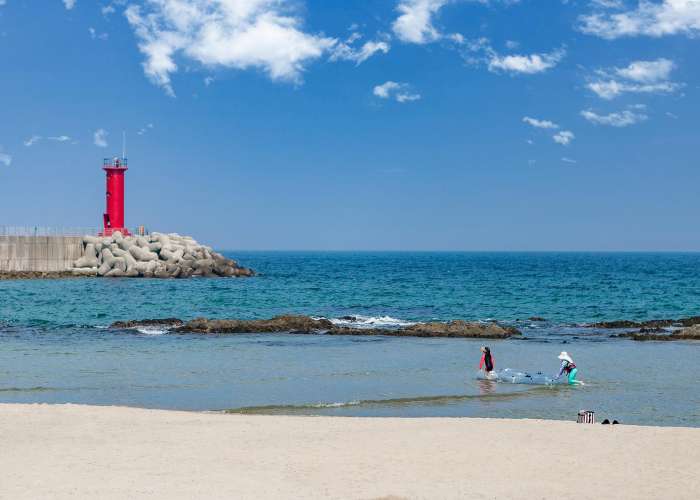
This is where the clear waters of Gunseong River flow into the sea. The sandy beach stretches 1 km in length and 50 m in width, with a gentle slope of 10–20 degrees. The sand is fine and the water is crystal clear. Its shallow depth makes it an ideal condition for a swimming beach. Nearby attractions include Deungmyeongnakgasa Temple, Deungmyeong Beach, Gyeongpodae Pavilion, Seongyojang House, Ojukheon House, and Jeongdongjin.
Tourist Guide
Anin Beach can be reached by following National Route 7 toward Donghae and Samcheok; the beach entrance will appear on the left. It is located about 12 km from Gangneung City Hall. Although the sand is fine, there are many rocks along the shore. Visitors can enjoy catching shellfish or fishing for species such as wrasse, flounder, black porgy, and rockfish. It is also a popular destination for summer vacationers.
Travel Tips
Near Anin Beach is Aninjin Port, where visitors can enjoy sea fishing and skin scuba diving. To the south lies Unification Park, which features a Security Exhibition Hall and a Naval Vessel Exhibition Hall. There, visitors can explore the infiltration site of a North Korean submarine from 1996 and experience a security-themed hiking trail. Further south is Jeongdongjin. Close to Anin Beach is Haerangdang Shrine, where memorial rites were held for gisaeng (female entertainers). According to oral tradition, a magistrate of Gangneung once fell to his death while enjoying a swing ride with a gisaeng. Afterward, storms and poor fishing plagued the sea, prompting villagers to perform rituals. It is said that after the rites, the storms subsided and the fish returned in abundance.
-
-
Jeong Dong Jin, Okgye
Imhae Natural Recreation Forest
A seaside forest retreat with ocean views
Overview
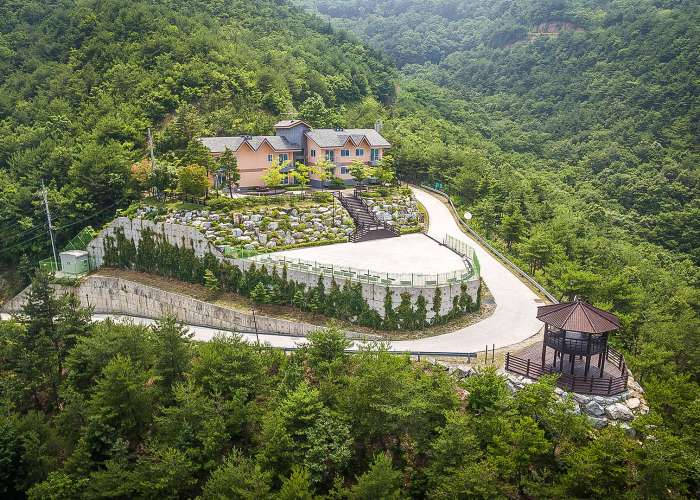
Imhae Natural Recreation Forest offers breathtaking coastal scenery along the East Sea. Backed by Mt. Gwaebangsan, it is a unique forest retreat where visitors can experience both the beauty of Korea’s sea and mountains in one place. Visitors can enjoy a relaxing forest bathing experience along the “Anbo Hiking Trail,” which is designed for easy and comfortable walking.
Travel Guide
Imhae Natural Recreation Forest is located on Yulgok-ro in Gangdong-myeon, Gangneung. Accommodation is available in three buildings: “Haneul-dong (Sky Building),” “Gureum-dong (Cloud Building),” and “Bada-dong (Sea Building).” There is also an observatory on-site, allowing visitors to fully immerse themselves in the tranquil and serene atmosphere of the forest while enjoying a restful retreat in harmony with nature.
Travel Tips
Gangneung Imhae Natural Recreation Forest is the only forest retreat in Korea where visitors can simultaneously enjoy the scenery of the blue sea and the mountains, attracting numerous travelers from across the country. From the forest, visitors can take in panoramic views of the vast blue East Sea, while Mt. Gwaebangsan, which surrounds the forest like a folding screen, harmonizes beautifully with the sea to provide healing relaxation for both body and mind.Visitors can also enjoy scenic driving routes around the area. Behind the forest, an Anbo experiential hiking trail connects to Section 8 of the Bau-gil Trail, where visitors can enjoy forest bathing through trekking and witness stunning sunrise views.There are three hiking courses available at Gangneung Imhae Natural Recreation Forest. The first course is an 8.3 km route starting from Aninjin 2-ri Plaza and passing through Samubong Peak, Mt. Gwaebangsan, Dangjip, Hill 183, and ending at Jeongdongjin, taking approximately 3 hours and 10 minutes. The second course is a 7.7 km route from Aninjin 2-ri Plaza through Samubong Peak, Mt. Gwaebangsan, Dangjin, Cheonghaksan Mountain, and Imgok-ri, taking about 3 hours and 20 minutes. The final course is a short route from the forest to Samubong Peak, which takes approximately 35 minutes.The accommodation facilities are clean and compact condo-style units equipped with cooking facilities. There are a total of 18 rooms: 8 in Haneul-dong, 7 in Gureum-dong, and 3 in Bada-dong.Nearby attractions within a 10 km radius include major tourist sites in Gangneung such as Unification Park, Hourglass Park, Jeongdongjin, Deungmyeongnakgasa Temple, and Haslla Art World Museum. In particular, Haslla Art World Museum offers a stunning backdrop overlooking the vast East Sea, making visitors feel as if they are viewing artworks above the ocean, with diverse exhibitions and artistic themes that leave a lasting impression.
-
-
Jeong Dong Jin, Okgye
Geumjin Port
The southernmost port of Gangneung
Introduction
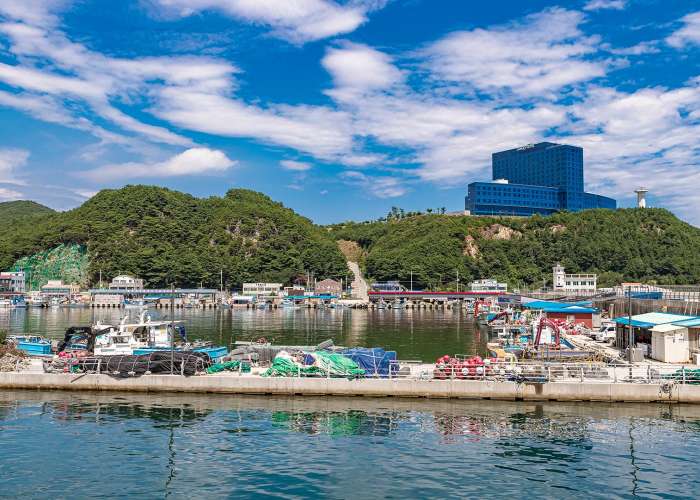
Geumjin Port is primarily engaged in drift gill net fishing and set net fishing. A master plan for its basic facilities was established in 1980, and a hydraulic model test was conducted in 1983. Approximately 58 households are involved in fishing activities here. Major catches include herring, squid, Atka mackerel, olive flounder, flounder, sand lance, octopus, and abalone. Auctions are typically held around 8:00 AM. Herring is abundantly caught from November to February, while olive flounder is mainly caught from February to May.
Tourist Guide
Located within a 5-minute drive from Simgok-ri along a scenic coastal road, Geumjin Port attracts many visitors on weekends who sit along the breakwater, enjoying the harbor view while fishing. Jeongdongjin, famous as a filming location for the drama “Sandglass,” means the easternmost docking point when viewed from Gwanghwamun in Seoul. At the end of the year, crowds gather here to witness the magnificent sunrise.
Travel Tips
Geumjin Port is a small harbor that is not widely known. However, it is considered a hidden gem of the East Coast. One must not miss the local cuisine near the port, especially the savory and chewy seasoned raw flounder salad and the refreshing king crab kalguksu (noodle soup). The king crab kalguksu is made using a traditional Gangwon-style soybean paste broth, delivering a rich, spicy yet refreshing flavor without artificial seasoning, preserving the authentic taste of king crab.Geumjin Port still retains the classic appearance of a typical port from the 1960s–70s, with its pristine seawater gently rippling. It attracts visitors who long for the nostalgic charm of old harbors. However, due to aging facilities and limited hinterland space, fishermen experience inconvenience, and there are concerns about safety accidents caused by sediment buildup at the port entrance and within the harbor. The city of Gangneung is planning improvements to address these issues.In addition to the charming Geumjin Port, Okgye-myeon is also home to notable attractions such as Okgye Cave, a limestone cave, and the Geumokgye Quarantine Monument.
-
-
Jeong Dong Jin, Okgye
Yeomjeon Beach
A simple beach with a sandy shoreline
Introduction
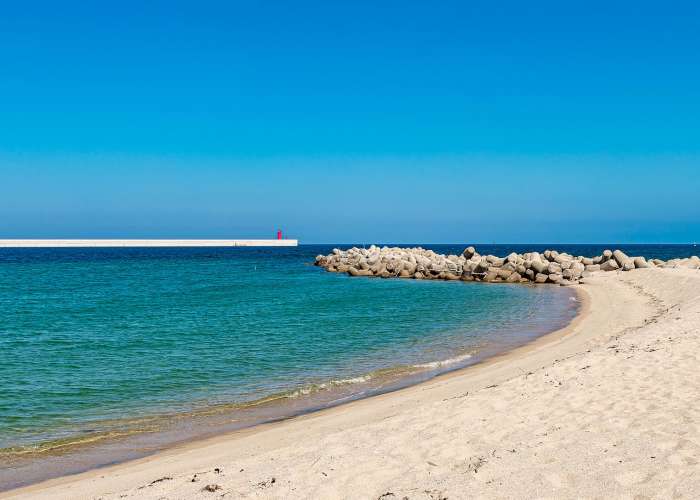
Yeomjeon Beach is located in Anin-ri, Gangdong-myeon, Gangneung-si, Gangwon State. This small and quiet beach offers a relaxing retreat with emerald-colored waters. Although it is a modest-sized beach, it is equipped with convenient facilities such as showers, changing rooms, restrooms, and a campsite.
Tour Guide
Yeomjeon Beach is generally peaceful and relatively small, but it is rich in a variety of fish species, making it a popular destination for fishing enthusiasts. Visitors are encouraged to enjoy leisurely fishing throughout all four seasons, catching various types of fish. Despite its small size, the beach is well-equipped with facilities for tourists.
Travel Tips
Yeomjeon Beach is a simple beach featuring a wide sandy shore. Until the 1960s, salt fields were located beneath the Yeongdong Thermal Power Plant, and due to its proximity to Gunseon River, where seawater and freshwater meet, it has become a popular fishing spot for tourists. If you are looking for a quiet and serene natural setting to relax, Yeomjeon Beach is highly recommended.In spring, mullet migrate from the sea into freshwater, offering an exciting opportunity to catch large, arm-sized fish using casting nets. After the mullet season, schools of halfbeak begin to appear, attracting fishing enthusiasts. In winter, black porgy season provides another enjoyable fishing experience. In addition to seasonal catches, a wide variety of fish such as wrasse and flounder can be found throughout the year, with marine worms commonly used as bait.Besides fishing, tying leftover pork belly or meat heads to a line and catching small crabs hiding in rock crevices can create unique and memorable experiences. Around Yeomjeon Beach, you can also see numerous flounder fish farms.Between Jeongdongjin Station and Yeomjeon Beach, there is a scenic walking route with beautiful ocean views, perfect for a leisurely stroll and relaxation.In Gangneung, Jang Kalguksu (spicy noodle soup) is a local specialty. There are well-known restaurants near Yeomjeon Beach, so visitors are encouraged to enjoy a bowl after spending time at the beach. Additionally, many seafood restaurants nearby offer fresh raw fish, making it a great place to savor the flavors of the East Sea.
-
-
Jeong Dong Jin, Okgye
Anin Port
A quiet, small harbor perfect for travelers seeking tranquility
Introduction
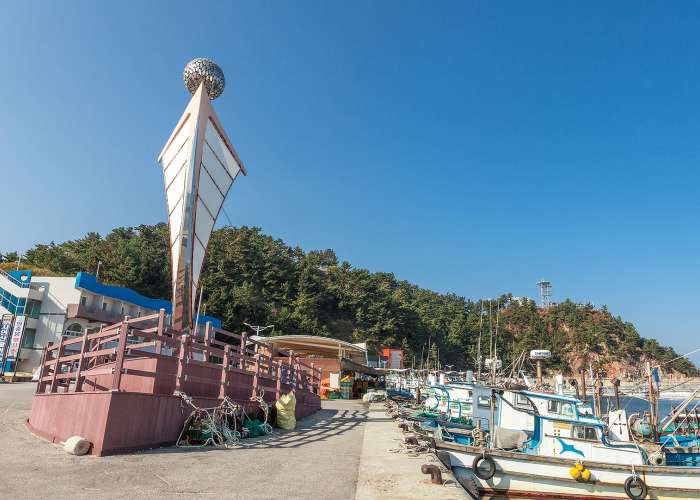
Anin is located eastward when viewed from Chilsadang, the administrative office of Gangneung city during the Joseon Dynasty. The name “Anin” combines “An,” meaning comfort, and “In,” indicating the east direction, signifying a peaceful place to the east of Gangneung. Around 85 households in Anin are engaged in fishing, with approximately 42 fishing vessels. The main catch includes flounder and halibut, along with abalone and various seaweeds. Notably, halibut and abalone are actively farmed. The primary coastal fishing grounds lie within 1–5 km offshore. The main fishing season runs from October to February, primarily harvesting flounder and halibut. Where the Gunsun River meets the sea, mullets are abundant, attracting local fishing enthusiasts. Every year, a rich harvest festival is held on March 3 and September 9.
Tourist Guide
A little further down from Anin Port, you will reach Jeongdongjin. Here, visitors can purchase fresh seafood and enjoy nearby golf courses, offering a scenic view of the expansive sea while playing. There are also horseback riding centers and natural recreational forests nearby, providing memorable experiences for families with children.
Travel Tips
One may wonder, “Can such deep blue waters exist in Korea?” The sea at Anin Port is so clear that its depth seems immeasurable. Even during peak seasons in Gangneung, the harbor rarely accommodates more than 500 visitors, offering a tranquil experience for families or couples seeking quiet reflection. The beachside restrooms are exceptionally clean, and lodging is conveniently available right in front. Anin Port is renowned for sea fishing, including flounder and mullet fishing, making it a beloved spot for anglers. Visitors are highly encouraged to try sea fishing; the unique thrill of catching fish often draws people back to Anin Port. Freshly caught sashimi can be enjoyed at local restaurants at reasonable prices, or visitors can purchase seafood at nearby centers without fishing. The hospitable spirit of Gangwon-do is felt throughout. Anin Port also hosts a participant flounder experience center, recommended for those interested. The nearby Yeomjeon Beach offers gentle, serene waters and wide sandy beaches, perfect for relaxation. If traveling by car, visiting Jeongdongjin further down is also recommended. Gangneung has many harbors and beaches along its long coastline, each offering a distinct atmosphere, and Jeongdongjin has its unique charm. Fresh sashimi from the East Coast tastes very different from that of the West Coast. In autumn, crabs make a particularly delicious meal. For those who prefer cooked dishes, seafood kalguksu (noodle soup), Chodang soft tofu, and Gangneung-style jjambbong are highly recommended. Families with children can enjoy horseback riding and natural recreational forests, while adults may enjoy golf and leisurely hobbies.
-
-
Jeong Dong Jin, Okgye
Simgok Port
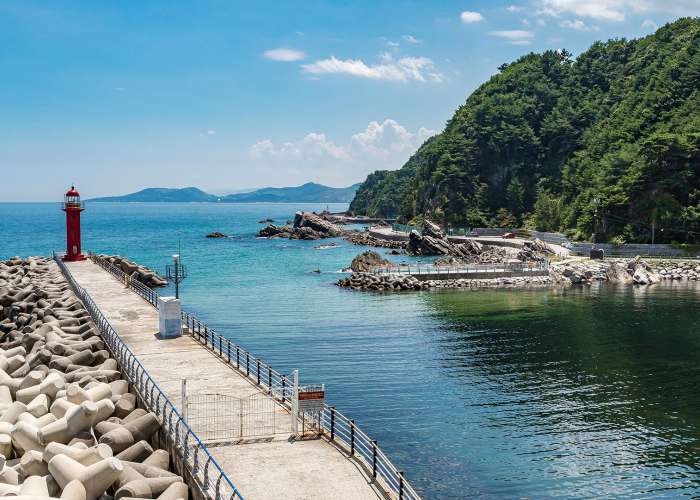
A harbor with stunning coastal cliff scenery
Introduction
The village is called “Simgok,” meaning “deep valley,” as it is located within a deep valley. It was also once referred to as “Jipil (紙筆)” because the village appears flat like paper laid on the ground, with the shape of a brush placed beside it. However, the name was officially established as Simgok in 1916 following administrative district reorganization. As a remote village nestled between mountain ranges on both sides, it is said that during the Korean War, the residents were unaware that a war had even broken out. Today, with the rise in popularity of Jeongdongjin as a sunrise destination, Simgok Port has gained attention. Surrounded by both mountains and the sea, it boasts exceptionally beautiful scenery.
Tourist Guide
Most residents are engaged in fishing, with representative catches including flounder, abalone, and saury. The naturally harvested rock laver (seaweed) from this area is of outstanding quality and was historically presented to the king. The port is also famous for flounder fishing using fishing boats in the nearby waters. From the sea, the view of the coastal cliffs facing the harbor is remarkably beautiful. Recently, a coastal road has been constructed connecting Geumjin Port in Okgye-myeon, passing through this area, and extending to Jeongdongjin Port, making it an emerging tourist attraction.
Travel Tips
As you descend from Jeongdongjin Sculpture Park, you will encounter Simgok Port, which reveals a tranquil and secluded atmosphere befitting a harbor nestled deep in a valley. With rocky cliffs on both sides and the sea embraced by mountains, it is well known as a scenic driving course. It is an ideal place to relax your mind when feeling stressed or to enjoy a weekend drive with family. Although it may be easy to pass by, it is one of the three most beautiful ports in Gangwon State. The three most beautiful ports in Gangwon State include Simgok Port, Namae Port located about 6 km from Jumunjin, and Chogok Port in Samcheok. At Simgok Port, the deep blue waves of the East Sea crash against rocks scattered across the water, creating a refreshing and awe-inspiring view. It gives the sensation of driving over the sea. Driving along the road of Simgok Port, a favorite course for couples, makes you truly realize why it is said to be the closest road to the sea on the Korean Peninsula. As you navigate the winding coastal road, it feels as though you are driving directly over the ocean. While the sea here is beautiful in summer, it is even more stunning in winter. When snow covers the mountains beside the road and the sea glows in deep cobalt blue, the entire landscape becomes like a painting.Around Simgok Port, you can find restaurants serving spicy fish stew made with “mangchi” fish, a local specialty caught year-round regardless of season, making it a representative fish of the area. A spoonful of this spicy stew, combined with the dramatic rocky scenery and deep blue sea, creates an unforgettable experience. Taking a motorboat ride from Jeongdongjin offers another perspective of the coastal reefs and cliffs. As the boat passes between the rocks, it feels as though it might collide with them, creating a thrilling sensation. It is also a great spot for sea fishing, with people enjoying fishing from the breakwater or venturing out by boat to fish near offshore reefs. However, fishing should be avoided on days with strong waves or swells.On clear days, the deep blue sea is vivid and beautiful, but rainy days add even more charm and atmosphere. Visiting on a rainy day may make you feel like the main character in a movie. While the sunrise along the East Coast is beautiful everywhere, the sunrise viewed from Simgok Port is particularly stunning as it rises between mountains, rocky cliffs, and reefs.
-
-
Jeong Dong Jin, Okgye
Dojik Beach
A 500-meter-long simple beach located at the southernmost end of Gangneung City
Introduction
Dojik Beach is a simple beach located in Dojik-ri, Okgye-myeon, at the southernmost part of Gangneung City. It stretches 500 meters in length and covers an area of 50,000㎡. The name “Dojik” comes from the word meaning “straight,” referring to the straight layout of the village. With the construction of the Donghae Expressway, the village was divided into two parts, and residents relocated as a group, leaving the original village no longer in existence. True to its name, this is a rare place where five transportation routes—national highway, railway, expressway, airway, and sea route—run parallel to each other.
Tour Guide
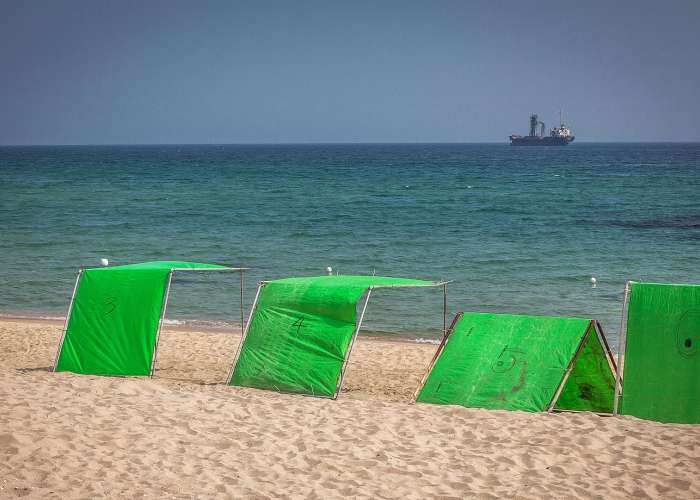
Dojik Beach is known for its clean sand and spacious parking area, making it a მშვიდ and popular destination for families. For accommodation, visitors can use local guesthouses. The beach features a simple parking lot of approximately 3,000㎡ and a campsite of about 1,000㎡ that can accommodate around 66 tents.Around Dojik Beach, fish such as wrasse, rockfish, and flounder are caught throughout the year. On weekends, it is common to see families enjoying fishing together, often using marine worms as bait. Four fishing boats operate year-round, harvesting octopus and clams. In spring, filefish and olive flounder are mainly caught, while in autumn, yellowtail and gizzard shad are the primary catch. Boats usually return to port around 2–3 PM.Seaweed (March–May), sea squirts (year-round), sea cucumbers (December–March), sea urchins (December–May), jinuwari seaweed (spring), hijiki (February–May), and laver (January–March) are also harvested, with returns to port around 1 PM.
Travel Tips
Located next to the well-known Mangsang Beach, Dojik Beach is the southernmost beach in Gangneung. Although not widely known, it is a place that quickly captures visitors’ hearts once experienced. Situated between Okgye Service Area and Donghae Service Area, the beach lies along the Yeongdong Line railway and the Donghae Expressway (Route 65), and can also be accessed via National Route 7 from Gangneung.As it is within a military zone, the beach is open only during the peak summer season. It offers a quiet and clean environment. To find accommodations, it is easier to cross the railway and expressway into Dojik-ri. The presence of barbed-wire fences creates a solemn atmosphere and can evoke a sense of the division of Korea.Recently, there have been efforts to build modern pensions, but there is a hope that accommodations reflecting the local character of Dojik-ri will be preserved rather than overly urbanized styles. Instead of uniform beaches, it is desirable to maintain the unique identity of each region.Although the sandy beach is not very wide, there is a campsite available. It includes shower facilities, and the ground is natural soil. Camping is available for approximately 10,000 KRW per night. This beach is ideal for campers seeking a quiet environment, but the campsite is not operated during winter due to freezing issues with water facilities.Like other beaches, Dojik Beach operates during July and August, and there is no entrance fee. While many visitors come to enjoy swimming, it is also popular among anglers targeting wrasse.After enjoying the beach, cross the road and explore Dojik-ri village. Although the original village disappeared due to the expressway, relocated residents have settled across the beach. The village still retains the appearance of a traditional fishing community, including a Seonangdang shrine located on the hillside near the expressway. This wooden shrine hosts annual rituals.While such rituals may seem like stories of the past to outsiders, for local residents whose livelihood depends on fishing, they represent earnest wishes for safety, prosperity, and abundant catches. Observing the shrine, one cannot help but hope that these local traditions will not disappear under commercial development.Nearby attractions include Neulhaetsal Rural Experience Village (Manwoo Village), Daejin Village, and Mukho Port. Other nearby camping sites include Donghae Mangsang Auto Camping Site, Okgye Beach, and Nobong Auto Campground.
-
-
Jeong Dong Jin, Okgye
Hourglass Park
A charming park set against the backdrop of the East Sea and mountains
Introduction
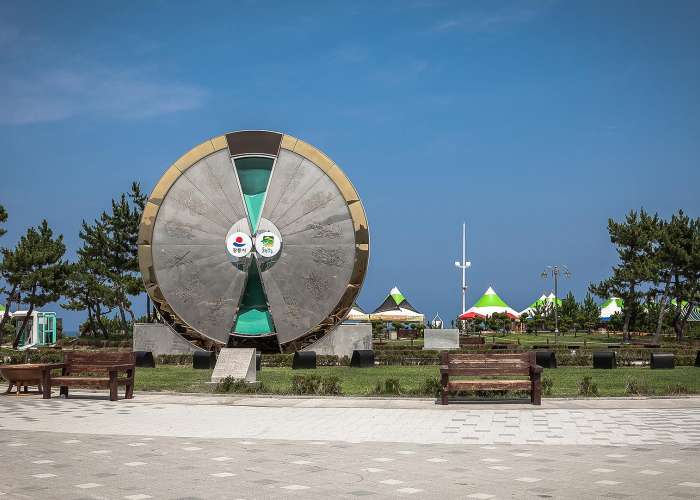
Jeongdongjin Hourglass Park was created in 1999 by Gangneung City and Samsung Electronics to commemorate the new millennium, with a total project cost of 1.28 billion KRW. The hourglass inside the park is the largest in the world, measuring 8.06 meters in diameter, 3.20 meters in width, weighing 40 tons, and containing 8 tons of sand. It takes exactly one year for all the sand inside the hourglass to fall from top to bottom.
Tourist Guide
Hourglass Park was established to commemorate both the popular drama “Sandglass” and the new millennium, and features the Jeongdongjin Millennium Hourglass. Nearby attractions include Jeongdongjin Sculpture Park, Jeongdongjin Station, and Jeongdongjin Beach. There are no admission or parking fees.
Travel Tips
Hourglass Park is modestly designed with the East Sea, surrounding mountains, and Jeongdongjin 2-ri village as its backdrop. At the center stands the hourglass, surrounded by pine trees, while benches are placed facing the sea. Unlike sundials or water clocks that indicate the current time, an hourglass measures the passage of time based on the volume of sand falling due to gravity. Historically, hourglasses were made in various durations such as 4 hours, 2 hours, 1 hour, and 30 minutes, as well as 28 seconds and 14 seconds for measuring ship speed. These were widely used until the 19th century, and today, a 3-minute hourglass is commonly used for boiling eggs. It is said that the hourglass was invented around the 8th century by a French clergyman named Liutprand.The Jeongdongjin Hourglass differs from the typical narrow-waisted glass shape, as it is designed in a round form to symbolize the infinity of time. The circular shape also represents the rising sun over the East Sea, while the 32-meter-long parallel train rails symbolize the eternal flow of time. The falling and accumulating sand signifies the continuity of time rather than a separation between the past and the future.Jeongdongjin, where the hourglass stands, is located directly east of the milestone marker in front of Gwanghwamun in Seoul. It is known as one of the first places on the Korean Peninsula to see the sunrise during the summer solstice, attracting many visitors. It is highly recommended to visit with family to enjoy the beautiful sunrise and explore Hourglass Park.
-
-
Jeong Dong Jin, Okgye
Jeongdong–Simgok Badabuchae-gil Coastal Trail
A coastal terrace formed by the waves of Jeongdongjin Beach
Introduction
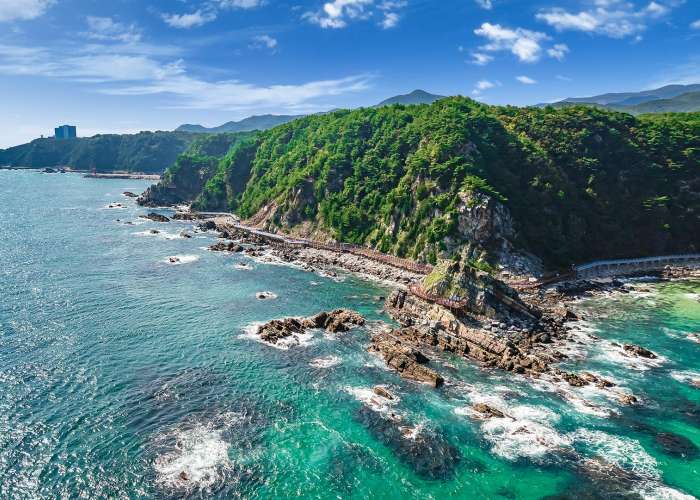
Jeongdong–Simgok Badabuchae-gil is a coastal terrace formation located along Jeongdongjin Beach. It is the largest coastal terrace in Korea and is exceptionally well preserved, earning designation as a national heritage site. A 3.01 km coastal trail connecting Jeongdongjin to Simgok Port (along Heonhwa-ro) was opened in September 2016. Visitors can walk along the elevated coastal terrace and enjoy close-up views of the spectacular scenery created by waves crashing against the cliffs. The terraces appear at approximately every 10 meters up to an elevation of 160 meters, offering a chance to observe diverse coastal terrace formations.
Tour Guide
From Gangneung City, drive southeast along National Route 7 for about 8 km to reach Anin Intersection. Turn left toward Jeongdongjin and Anin-ri, then at Mojeon Intersection, turn right toward Donghae and Okgye. After driving another 8 km, you will arrive at Jeongdongjin, a famous sunrise destination. With the construction of the coastal terrace trail, visitors can now observe various formations that were previously inaccessible. Along the way, coastal guard posts and barbed-wire fences partially obscure the sea, creating a bittersweet contrast with the beautiful coastal scenery. One can look forward to the day when the fences are removed, revealing the full beauty of the blue sea and coastal terraces.
Travel Tips
The view of the coastal terrace from Jeongdongjin Sculpture Park differs greatly from the perspective seen from Okgye Beach. On the way to Okgye Beach, you can enjoy views of the Sun Cruise Hotel and yacht marina, with spaces available for relaxing with a cup of coffee or shopping. It is recommended to take your time and enjoy the coastal scenery along with various activities. The area is also popular for photography, making it an excellent destination for photography enthusiasts and groups.