Gyeongpo District
- Home
- Tour
- Nature Tour
- Gyeongpo District
-
-
Gyeongpo Area
Gyeongpo Beach
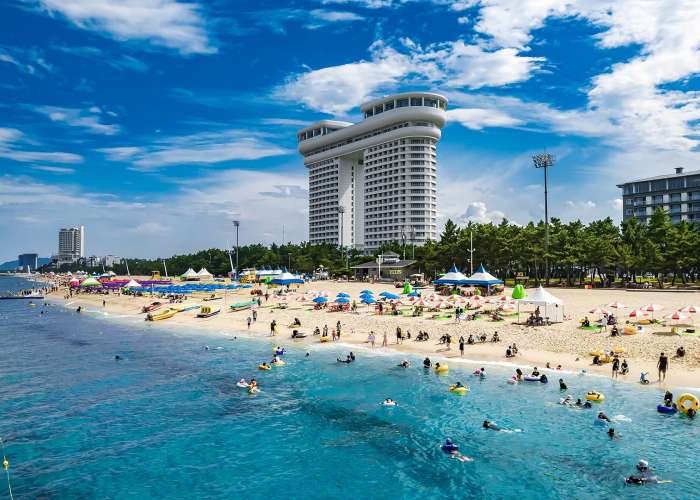
Summer beach famous for having many young visitors
Introduction
Gyeongpo Beach in Anhyeon-dong, Gangneung-si, Gangwon-do is one of the best beaches to visit in the summertime. There is saying, if you want to feel the youthful energy of Korea during the hot summer, go to Haeundae in Busan or Gyeongpodae in Gangneung. Many young people come to Gyeongpo Beach and as a result family visitors have spread to other beaches in Yangyang and Goseong. Gyeongpo is famous for being the longest coastal beach. Located 6km to the north of the city center and 1km from Gyeongpodae Pavilion, the beach shows off the clear waters of the East Sea along and shining sand. The parasols that cover the beach in the summertime look as if paint has been splashed on the beach and create a splendid view. Only after seeing this sight has your Gangneung travels truly begun.
Tourist guide
Gyeongpo Beach can be reached in 15 minutes from downtown Gangneung. Once you set foot on the beach, you are greeted by the fresh smell of the ocean and the rough sound of the waves. The open beach view will lighthen your heart and let your worries and troubles go away. It is a very attractive tourist site. After arriving at Gyeongpo Beach, you can enjoy a nice drive along the Beach on the tree-lined street. There are cafes you can visit that fit your taste and enjoy Gyeongpo Beach as you like.
Tourist Tips
In Gwandongbyeolgok, one of the fathers of lyrical literature Jeong Cheol described Gyeongpo in mid Choseon Period as "Following the royal azaleas of Hyeonsan Mountain that the dinnertime sunlight slightly shines past, I rode the wagon that the Taoist gods ride and went down to Gyeongpo". Also, on hit TV show "Runningman" host Yoo Jae-suk said "I love Gyeongpodae" and the sight became more famous. One of the top eight famous sites in Eastern Korea, you can see the moon in five different ways at Gyeongpodae. Gyeongpodae is beautiful year round with cherry blossoms in the spring, as the perfect summer getaway location, waterlilies in the fall, and snow covered pine trees in the winter. Gyeonpo Beach is 1.8km long, with waves coming ashore as if trying to swallow something, and 1.44㎢ of white sand and 4km of pine trees surrounding it as if it were a folding screen insulating the area from the rest of the world. Gyeonpo Beach is beautiful with a unique harmony between dynamic and calm forces. In the spring, the greenish water washes ashore from Oribawi Rock and Sinmibawi Rock and hits the white sand. In the summer, it is an ocean where you can enjoy and make memories in the sizzling heat. In the fall, it is a beach you would want to walk alone on. In the winter, it is a beach where someone just might come visit you from afar. It changes every season to give visitors a sense of serenity and a lasting impression.
-
-
Gyeongpo Area
Gyeongpodae Pavilion
On the side is an arm shaped the gambrel roof house
Introduction
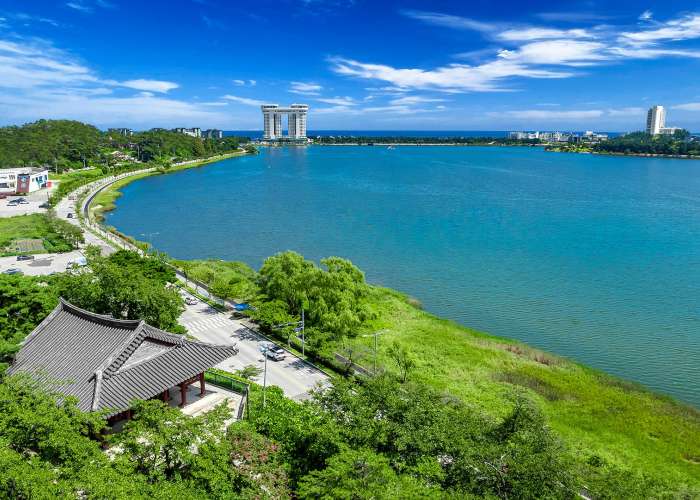
'Gyeongpodae Pavilion' represents one of Gangneung's scenic spots where it is located at Gyeongpo-ro, Gangneung-si, Gangwon-do, and it has been designated as the sixth Gangwon-do cultural asset. 'Gyeongpodae Pavilion' shows the Goryeo Dynasty's culture that mainly consists of 6 spaces in front, 5 spaces on the side, and 32 pillars.
Tourist guide
Near 'Gyeongpodae Pavilion' is the 'Gyeongpo Beach' and 'Gyeongpoho Lake', during new years at 'Gyeongpo Beach' there are many tourists who visit to see the sunrise, so it is highly recommended to reserve accommodations beforehand. Also, 'Gyeongpoho Lake' is close to 'Chodang-dong' where the 'Chodang Sundubu' is famous which is one of delicacy's of this area and is recommended for tourists to visit.
Tourist Tips
It is considered that King Chungsuk of Goryeo in year 13 founded 'Bakseuk' which is known as 'Banghaejeong' in the Anreumsa Temple of Gangwon-do and 'Inwolsa Temple' that was located in the back of the mountains, yet later the location has been said to have been moved but there is still no detailed evidence. At the 'Gyeongpodae Pavilion' it is known that Yulgok Yi I at age 10 built the 'Gyeongpo Daebu' which are letters of nouns such as the 'uhsaeji' of 'sukjong' and 'sangryangmun' of johamang. Here you can see 'Gyeongpo 8 gyeong' and 'Gyeongpo wolsam' that has been handed down to the great spectacle of a strong man.
-
-
Gyeongpo Area
Anmok Beach
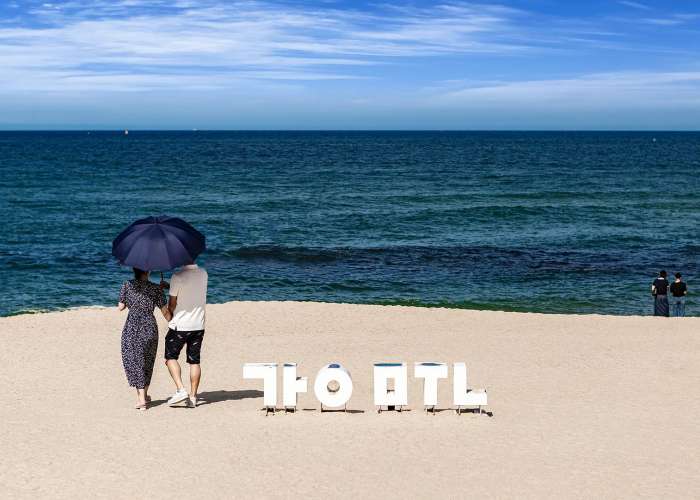
A white sand beach with soft sand stretching away
Introduction
Gangneung Anmok Beach is considered one of the most beautiful coffee streets nationwide. It holds a coffee festival in spring and fall and has a long coastal line, along with visitors can drive to look around many other tourist sites. In particular, some famous coffee shops present not only their own unique coffee aromas and tastes but also delicious desserts.
Tourist guide
Gangneung Anmok Beach is located at the southernmost part of Gangneung. While driving to the north, visitors can see Gangmun Beach and Gyeongpo Beach in order. Therefore, it would be a good idea to plan a travel course starting from Anmok Beach. After tasting coffee in Gangneung Beach, it is recommended to go up in the direction of Gangmun Beach, try a hamburger from a famous home-made hamburger restaurant, take pictures in a photo zone, go up to Gyeongpo Beach, look around Gyeongpo Lake, and go to Jumunjin. By doing so, visitors can enjoy a grand finale of Gangneung Beach. Instead of the hamburger, it is also recommended to try Chodang Soft Tofu.
Tourist Tips
It is possible to visit Anmok Beach not only by car but also by public transportation. It takes about 40 minutes from Intercity Bus Terminal. It is recommended for families or couples to buy a cup of coffee from Gangneung's tourist attraction Anmok Beach Coffee Street and take a walk on the beach.
-
-
Gyeongpo Area
Gangmun Beach
A beautiful beach featuring the Sotdae Bridge stretching across the shoreline
Introduction
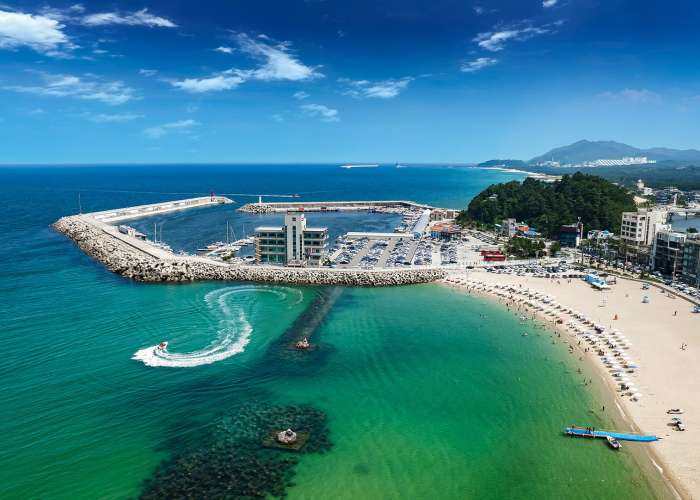
Gangmun Beach is located in Gangmun-dong and is home to a small nearby harbor called Gangmun Port, where visitors can enjoy fresh raw fish caught at dawn at nearby sashimi restaurants, and the area is conveniently close to well-maintained accommodation facilities as well as the Gyeongpo tourist district. From Gangmun Beach, visitors can take a boat ride of approximately 5 to 10 minutes to a diving point where boats anchor above waters 5 to 30 meters deep, offering a chance to admire a vast underwater landscape filled with natural rock formations, sea anemones, and large fish, making it a popular destination for scuba diving enthusiasts, and it also provides underwater diving experiences especially designed for honeymoon couples who wish to create lasting memories. In addition, Gangmun Port is home to 16 fishing boats that regularly catch flounder, greenling, octopus, small clams (jjebok), sea urchins, sea squirts, and sea cucumbers, while seasonal catches include flatfish and large clams in spring, Spanish mackerel in summer and autumn, and rockfish in winter, and fishing enthusiasts can also enjoy catching dace and greenling at the harbor.
Tourist Guide
Gangmun Beach is connected to Gyeongpo Beach but tends to be less crowded, and while Gyeongpo Beach is widely visited by tourists, Gangmun Beach is more commonly frequented by local residents of Gangneung, with the road passing through Gangmun Live Fish Town and across Gangmun Bridge leading directly to the beach, and beyond the beach, a pine forest trail known as the Ttangjaebong Walking Path continues for approximately 3 kilometers all the way to Anmok Beach.
Travel Tips
If you cross the road from the famous Chodang Tofu Village in Gangneung, you will immediately arrive at Gangmun Beach, where a sign reading “Gangmun Jinttobaegi Village” stands at the entrance, and “Jinttobaegi” is known as a regional term in the Yeongdong area referring to a Sotdae, a traditional wooden totem pole erected at the entrance of a village to pray for peace and prosperity. In Gangmun Village in Gangneung, a ritual called Seonangje is held three times a year for the Jinttobaegi, which is believed to bring safety, abundant harvests, and plentiful fishing, although the exact origin of the term “Jinttobaegi” is not clearly known and is said to originate from local folk beliefs. The Sotdae standing tall toward the sky in Sotdae Park creates a sense of calm and stability upon entering the village, and stories about the Sotdae as well as passages from “Gwandong Byeolgok,” a classical work by the poet Jeong Cheol that includes verses about Gangneung, are engraved on stone monuments to kindly explain the cultural background to visitors. As is common along the East Coast, visitors can see squid hung out in long rows to dry in the sea breeze like laundry, and as you walk through the alleys, you will encounter the gently curved Sotdae Bridge, which appears to draw a boundary between the river and the sea, and when crossing the bridge, the view of the ocean feels much closer and different from the view from the shore, while in the middle of the bridge there is a spot where visitors can toss coins and make wishes, making it a meaningful place to send hopes across the vast sea. One of the reasons Gangmun Beach has gained popularity is that it was featured as a filming location in the MBC drama “She Was Pretty,” starring Park Seo-joon and Hwang Jung-eum, where a memorable romantic scene was filmed, and at night, the Sotdae Bridge is reborn as a beautifully illuminated structure glowing in various colors, making it a must-visit destination for couples traveling to Gangneung. Gangmun Beach is also designated as a coastal plant protection area where local residents actively work to preserve the ecological environment, and during the summer season, facilities such as water fountains, showers, and restrooms are provided for the convenience of beachgoers, and when visiting Gangmun Beach, locals in Gangneung recommend trying rockfish seaweed soup, which is commonly served along the East Coast but is said to be especially delicious in Gangmun, making it a delightful culinary experience that enhances your trip.
-
-
Gyeongpo Area
Gyeongpo Lake
A lagoon located in Jeodong, Gangneung-si, Gangwon-do
Introduction
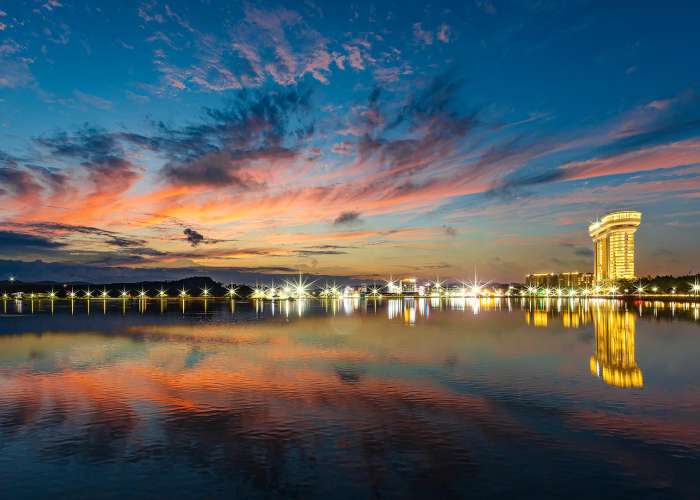
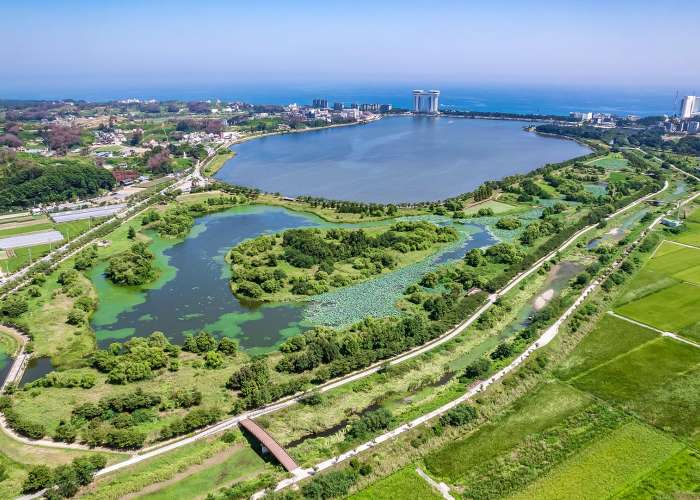
Gyeongpo Lake, also known as Gyeongho (鏡湖), is situated about 6 km north of the city center, with small streams such as Yucheon (楡川) flowing into it from the west. Originally, it was a large lake stretching around 12 km in circumference, but due to sediment accumulation, its perimeter has reduced to 4 km, and the water depth is now only about 1–2 meters. Gyeongpodae, perched atop a small hill on the western lakeshore, has been renowned as one of the Eight Scenic Spots of the Gwandong region, with Gyeongpo Lake as its backdrop. The lake is famous for its surrounding ancient pine forests and cherry trees. A sandbar separates Gyeongpo Lake from the East Sea, forming Gyeongpo Beach.
Tourist Guide
Next to Gyeongpo Lake lies Gyeongpo Beach, the largest beach on the East Coast. Along with Gyeongpo Lake and Gyeongpodae, it was designated a coastal tourist site on June 26, 1982. As the top vacation spot representing the East Coast, Gyeongpo Beach stretches 6 km north of the city center and 1 km from Gyeongpodae, offering sweeping views of the East Sea. The combination of lively blue waves, wide white sandy beaches, and dense pine groves that quietly block out the noise of everyday life creates the beach’s unique beauty.
Tourist Tips
Gyeongpo Lake is beautiful in all seasons, but especially captivating in early summer when the lotus blooms. The area around the lake features bicycle paths, and visitors can rent bicycles or four-wheelers to circle the lake. The Gyeongpo Lake Cherry Blossom Festival held in spring is famous nationwide. Seeing cherry blossoms scattered over the lake and sea is as beautiful and poetic as the Jinhae Gunhangje Festival. After taking in the lake views, visiting Gyeongpo Beach is a must. Gyeongpo Beach is the largest in Gangneung, attracting substantial crowds during peak season. Seasonal festivals such as coffee and music festivals are held there, and local food options are plentiful.For those who have explored the largest Gyeongpo Beach and Lake, it’s recommended to enjoy other nearby attractions. In early summer (June–July), villages in Gangneung host a lotus festival, which is perfect for lotus lovers. To enjoy more of the sea, visiting Gangmun Beach just south of Gyeongpo Beach is a great option. Gangmun Beach is less crowded but boasts water as clear as Jeju Island and is surrounded by popular handmade burger restaurants. It is a favorite location for photography enthusiasts, with numerous scenic spots perfect for capturing memories. Gangneung is also famous for coffee, and visiting nearby coffee factories or the coffee street at Anmok Beach is highly recommended. On the way home, stopping by the Jungang Market to pick up some spicy fried chicken (dakgangjeong) ensures a hearty and satisfying conclusion to your trip.
-
-
Gyeongpo Area
Gyeongpo Eco Marsh Park
Prickly waterlily flowers which revived within half a century can be seen in eco marsh park
Introduction
Gyeongpo Eco Marsh Park is a park adjacent to the Gyeongpoho Lake. Upon entering the entrance of the park, there appear lotus and prickly waterlily flowers. Sometimes, the prickly waterlily flowers cannot be seen in the foxnut marsh, so it is necessary to check appropriate seasons or visiting times in advance. In particular, visitors can go for a walk without any difficulty along a well-organized trail and deck. Above all, there are rare prickly waterlily flowers which revived within half a century.
Tourist guide
While walking around the Gyeongpo Eco Marsh Park, visitors can see herons floating leisurely on the water. Passing by the prickly waterlily complex, they can go to a well-organized trail and pass the river by ferry. If a ferry is on the opposite side, visitors have only to turn a handle to have it come back. For boarding and crossing, they have only to pull a thick rope at the middle of the ferry. Unless it is a blooming season, visitors cannot see lotus flowering. There is also the Gyeongpo waterway, but it is difficult to go fishing there due to its wetland. After walking along the deck, visitors can reach the lotus complex and see lotus flowering only in the morning or in sunny days.
Tourist Tips
In Gyeongpo Marsh, visitors can take a walk in the lotus complex and ride on a ferry. So, it would be a good idea to come with children. They can get its brochure from the information center at its entrance. It is near Gyeongpoho Lake, visitors can see people riding a bicycle or jogging. It is good to see nameless wild flowers along the trail. The best season to see lotus flowers is from early to middle of July. So, it would be better to check a schedule in advance. There are prickly waterlily flowers at the entrance and their floral leaves are different from those of lotus. As walking more, there appears a lotus complex where lotus flowers blooming look very brilliant and splendid.
-
-
Gyeongpo Area
Sageunjin Beach
A cozy beach shaded by a dense pine forest
Introduction
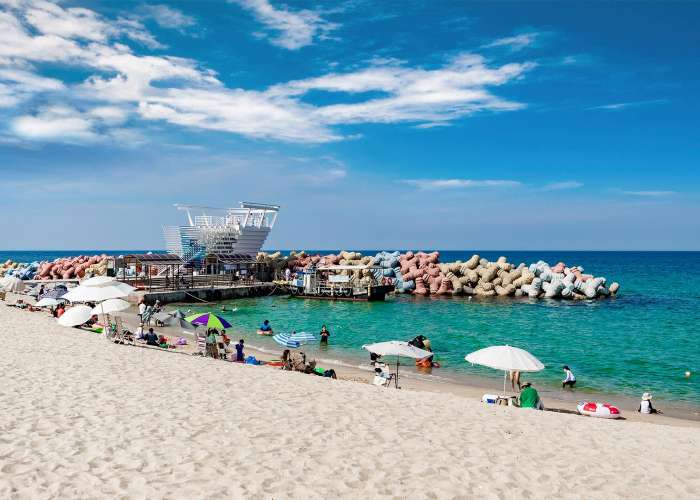
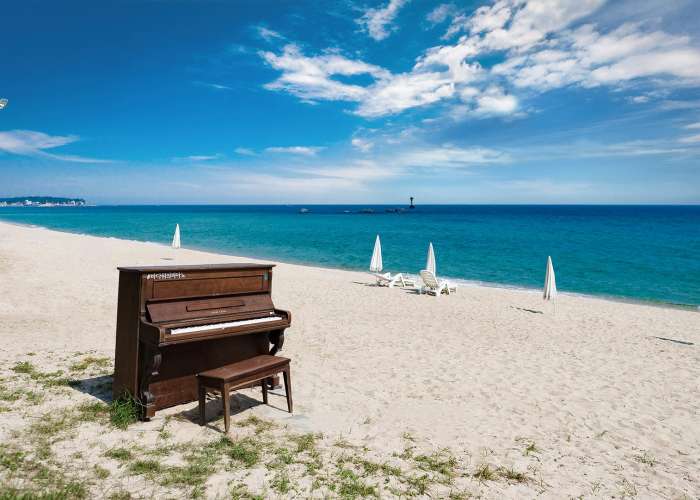
“Sageunjin Beach” is a beach located in Anhyeon-dong, Gangneung-si, Gangwon State. The name “Sageunjin” is derived from the meaning “a ferry dock where a pottery merchant once lived.” Sageunjin Beach is connected to Gyeongpo Beach and features a wide sandy shore and a beautiful natural landscape formed by a lush pine forest.
Tourist Guide
Sageunjin Beach offers a wide sandy beach harmonized with the blue sea, and the surrounding dense pine forest provides camping grounds where visitors can pitch tents, as well as auto camping facilities. Nearby attractions include Ojukheon House, Gangneung Municipal Museum, Seongyojang House, and Gyeongpodae Pavilion.
Travel Tips
Sageunjin Beach is a simple beach with a sandy shore, directly connected to Gyeongpo Beach, making it convenient to use. The clear blue sea and nearby clean accommodations attract many visitors. After enjoying water activities at Sageunjin Beach, visitors are encouraged to explore nearby attractions such as Ojukheon House, Gangneung Municipal Museum, Seongyojang House, and Gyeongpodae Pavilion.Ojukheon House, located in Jukheon-dong, Gangneung-si, Gangwon State, is a wooden structure from the mid-Joseon Dynasty and was designated as Treasure No. 165 on January 21, 1963. The building has a single-story structure with a hipped-and-gabled roof, consisting of three bays in the front and two bays on the side. Ojukheon is the birthplace of the renowned scholar Yulgok Yi I and Shin Saimdang, and was built during the reign of King Jungjong of the Joseon Dynasty. It is considered one of the oldest residential buildings in Korea and holds significant architectural value.The Gangneung Municipal Museum, located in Jukheon-dong, houses and exhibits folk materials from the Yeongdong region, showcasing the history and culture of Gangneung while offering various programs.Seongyojang House, located in Unjeong-dong, Gangneung-si, was first inhabited by Yi Naebeon, a prominent figure in the Gangneung region, and has been passed down through generations. It is designated as Important Folklore Cultural Heritage No. 5. The name “Seongyojang” originates from the meaning “to cross by boat,” as the village was once called “Baedari Village.” The complex consists of buildings such as Anchae (main quarters), Yeolhwadang, Dongbyeoldang, and Hwallaejeong, which collectively represent the elegance of upper-class residences from the Joseon Dynasty.Additionally, Gyeongpodae Pavilion, located on the northern shore of Gyeongpo Lake in Jeo-dong, Gangneung-si, is nearby. This pavilion, harmonized with the surrounding natural scenery, warmly welcomes visitors.
-
-
Gyeongpo Area
Sungeut Beach
A shallow-water beach ideal for family vacations
Introduction
Located north of Gyeongpo Beach, this small and simple beach features a 200-meter stretch of white sand and a total area of 6,000㎡. It is a cozy and compact seaside destination with a calm and peaceful atmosphere. The shallow waters make it particularly suitable for families with children. The gently sloping shoreline and easy access via public transportation add to its appeal.
Tourist Guide
Gangneung’s coastline is made up of 16 beaches, offering various sightseeing opportunities. Visitors can explore nearby Gyeongpo Beach, admire the beautiful lotus flowers floating on Gyeongpo Lake, stroll along the coffee street at Anmok Beach, take photos at the popular photo zone of Gangmun Beach, enjoy soft tofu dishes at Chodang Sundubu Village, or try Dakgangjeong (sweet crispy fried chicken) at Jungang Market.
Travel Tips
Sungeut Beach is located near Gyeongpo Beach and is known for its clean sandy shore, tranquil atmosphere, and shallow waters, making it perfect for family vacations. The beach offers convenient facilities such as free parking, an auto camping site, guesthouses, changing rooms, showers, and parasol rentals. Notably, the beach operates under the principle of “no overcharging,” which has attracted significant attention from media outlets and visitors alike. Since 2004, the Sungeut Beach Operation Committee has been running the “Gyeongpo Sungeut Marine Leisure Town” during the summer season, providing visitors with a variety of attractions and hands-on experiences. Although the beach is small in size, it is equipped with a convenience store and public restrooms, and parasol rentals are available for a relaxing beach experience. Due to its proximity to Gyeongpo Beach, visitors can enjoy a peaceful time at Sungeut Beach and then head to the livelier Gyeongpo Beach. A visit to nearby Gyeongpo Lake is also highly recommended.
-
-
Gyeongpo Area
Gyeongpo Ecological Retention Basin
A spectacular scene unfolds as fields of canola flowers and cosmos spread across the wide plains.
Introduction
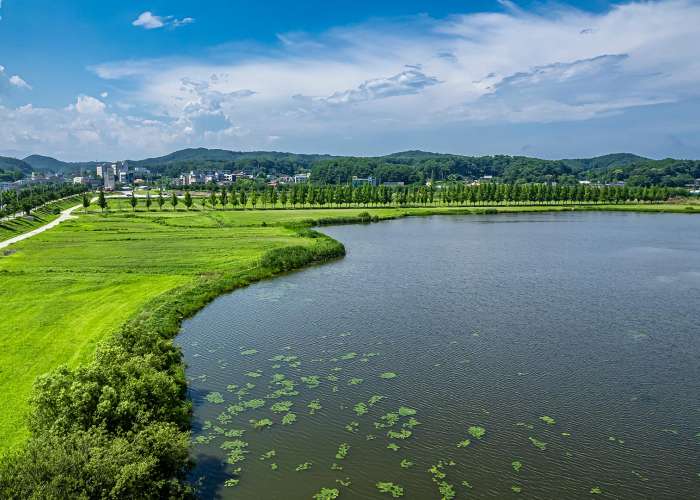
The Gyeongpo Ecological Retention Basin was established to prevent loss of life and property from flooding by creating a retention area based on river management plans and comprehensive flood prevention measures, due to concerns about river overflow during heavy rainfall. It is located between Ojukheon House, a famous attraction in Gangneung, and Gyeongpo Lake. In spring, bright yellow canola flowers bloom, while in autumn, cosmos flowers spread across the wide fields, creating a magnificent landscape. Another highlight is the opportunity to observe migratory birds such as egrets, mallards, and cranes.
Tour Guide
When you come down to the main road from Ojukheon, one of Gangneung’s landmarks, you will find the Gyeongpo Ecological Retention Basin directly across the street. It is not an ordinary wetland; walking trails have been developed so that visitors can fully enjoy the area. In spring, vibrant canola flower fields spread out beautifully, and in autumn, visitors can immerse themselves in the charm of blooming cosmos. This is one of Gangneung’s healing spots where you can relax while enjoying the fragrance of flowers carried by the sea breeze. In autumn, the fully blossomed cosmos sway gently, creating a stunning view. Walking through the fields of cosmos stretching out on both sides offers a magical experience unlike anywhere else.
Travel Tips
There is a charming tree-lined path crossing the Gyeongpo Ecological Retention Basin, making it perfect for a leisurely walk and pleasant conversation. The expansive lake and blue sky combine to create a beautiful landscape. If you follow the tree-lined path across the basin, you can also cross a bridge called Seongyojang Bridge. Bicycles are available for rent near Gyeongpodae. If walking is difficult, it is recommended to rent a bicycle and enjoy the scenic route from the Gyeongpo wetland to the ecological retention basin. Since walking around the entire wetland can cover several kilometers, it is advisable to prepare simple refreshments such as drinks in advance.
-
-
Gyeongpo Area
Sacheonjin Beach
A beach located in Sacheon-myeon, Gangneung-si, Gangwon-do
Introduction
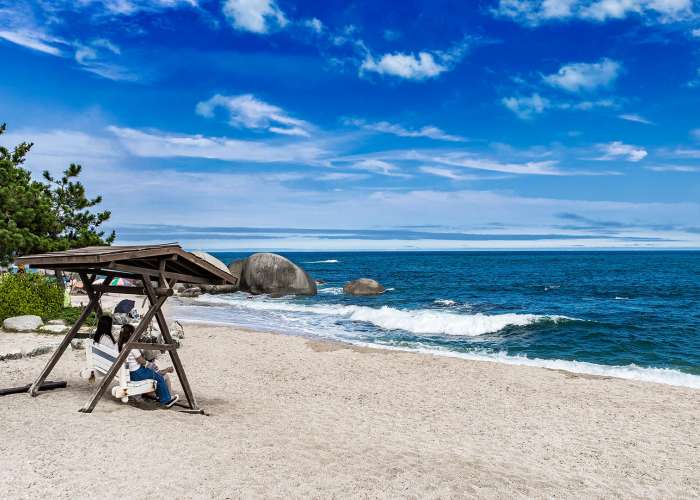
Sacheonjin Beach is located in Sacheonjin-ri, Sacheon-myeon. It features a wide sandy shore and is situated next to Sacheon Port, where visitors can purchase and enjoy fresh sashimi at affordable prices. The seawater is shallow, calm, and beautifully clear, making it an ideal place for a relaxing stay. Clean and well-maintained guesthouses are available nearby, making it a great destination for multi-day visits.The beach is particularly popular among sea fishing enthusiasts who frequent Sacheon Port. Common catches include greenling and flounder throughout the year, black porgy in spring, mullet in summer, and mackerel in autumn. In addition, the presence of a yacht marina in Gangwon Special Self-Governing Province adds an exotic charm, attracting many visitors.
Tourist Guide
Sacheonjin Port not only serves as a tourist attraction but is also a major hub for the fishing industry, with a wide variety of fish being caught. Common catches include squid, sand lance, flounder, and octopus. Scallops, which are about the size of a rice paddle, are farmed here and generate high income. At the scallop direct sales market, visitors can enjoy fresh shellfish at reasonable prices.The main coastal fishing grounds are located approximately 1–7 km offshore. Seasonal catches include sand lance from October to December and squid from April to December.
Travel Tips
Located about 5 minutes from Gyeongpodae and about 10 minutes by car from downtown Gangneung, Sacheonjin Beach is remarkably quieter compared to those areas. It retains the tranquil and gentle characteristics of the sea.In recent years, like the coffee street at Gangneung Port, the number of specialty coffee shops along the beach has increased. It has become a trend to form coffee shop clusters along scenic coastlines. As coffee culture grows, many people find joy in sipping a cup of coffee while gazing at the beautiful sea and waves.Some visitors confuse Sacheonjin Beach with Sacheon Beach. Based on Sacheonjin Port, the beach to the north is Sacheonjin Beach, while to the south—past the yacht marina and across the stream toward Gyeongpodae—is Sacheon Beach.Like other beaches along the East Coast, Sacheonjin Beach offers a peaceful atmosphere and stunning ocean views. Enjoying a cup of coffee here while admiring the sea can help melt away the stress of daily life.Beyond Sacheon Port, near the breakwater, lies the Gangneung Sacheon Yacht Stadium. Unlike other ports, it is enclosed in a way that separates it from the outside, where people enjoy yachting alongside white sandy shores. It is also a training ground for university yacht teams, and beginners can be seen freely practicing within the enclosed waters. Marine leisure camps are held here to promote yachting, and various programs are offered for students fatigued by studies and job preparation.At the entrance of Sacheonjin Port, uniquely shaped rocks rising from the blue sea, along with seagulls, create a captivating scene. Walking around the breakwater, visitors will find an arched bridge over rocky shores, enhancing the scenery, as well as a sculpture of a diver riding a shark welcoming guests.Fishing conditions are favorable both inside and outside the breakwater, especially for black porgy, along with a good variety of smaller fish. As a result, the breakwater is bustling with anglers on both weekdays and weekends. On the right side of the harbor stands a maritime safety watchtower, quietly ensuring the safety of those heading out to sea.From the beach, the red lighthouse of Sacheonjin Port is clearly visible. Here, visitors can purchase fresh sashimi or rent a fishing boat for sea fishing experiences.
-
-
Gyeongpo Area
Songjeong Beach
A place where you can enjoy a lush pine forest and a wide sandy beach
Overview
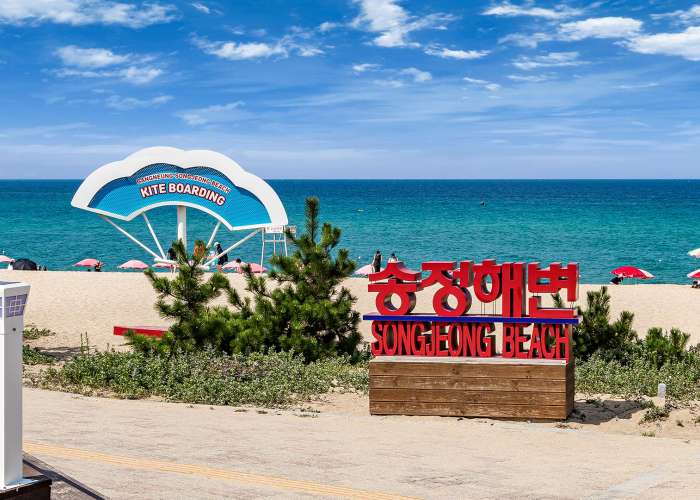
Located in Songjeong-dong, this beach features a 700-meter-long shoreline and a 28,000㎡ sandy beach. The surrounding pine forest is especially well known. According to legend, Choi Mun-han, the son-in-law of King Chungseok of the Goryeo Dynasty, brought eight pine trees from Songdo when he came to Gangneung and planted them here. The area was originally called “Palsongjeong” (Eight Pine Pavilion) and later became known as Songjeong.
Tourist Guide
Located in Songjeong-dong, the beach stretches 700 meters with a sandy area of 25,000㎡. The surrounding pine forest is famous. It is said that Choi Mun-han, the son-in-law of King Chungseok of the Goryeo Dynasty, brought eight pine trees from Songdo and planted them here, naming the place Palsongjeong before it became known as Songjeong. Nearby is the world’s largest Charmsori Gramophone & Edison Science Museum, where visitors can enjoy both a beach vacation and music appreciation. There are guesthouses available in the surrounding area, and for more accommodation options such as inns and hotels, visitors can stay in Gyeongpo or downtown Gangneung.
Travel Tips
Songjeong Beach, located between Gyeongpodae, Gangmun, and Anmok Beach, is a truly მშვიდ and cozy beach known for its photogenic scenery. It is convenient to reach by car, but also accessible by public transportation, taking about 20 minutes from the intercity bus terminal. Unlike other beaches, the entrance along the road features benches and a small snack stand, making it ideal for those on a drive to relax with a cup of tea or a drink while enjoying the sea, rather than for swimming. Pine trees line both sides of the coastal road, creating an excellent atmosphere. While driving is enjoyable, walking along the roadside is another way to enhance your travel experience. At the entrance of Songjeong Beach, there is a light green fence, which is expected to be removed soon as new facilities such as a management post, integrated surveillance cameras, and boundary lights are installed. Once removed, the beach will become even cleaner and more charming. Near the beach, there is a famous makguksu restaurant that the late Chung Ju-yung, founder of Hyundai Group, was known to visit whenever he came to Gangneung. There, you can enjoy both cold buckwheat noodles in broth (mul makguksu) and spicy mixed buckwheat noodles (bibim makguksu) to suit your taste. Pairing makguksu with buckwheat pancakes and locally brewed Gangneung makgeolli creates an exceptional dining experience.
-
-
Gyeongpo Area
Namhangjin Beach
A Quiet Secondary Beach Surrounded by Lush Pine Forests
Introduction
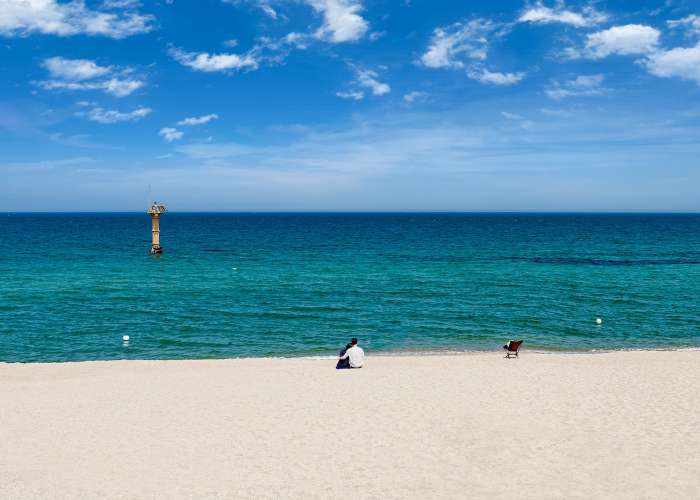
This is a small secondary beach featuring a 600-meter stretch of white sand covering approximately 24,000㎡. Namhangjin is a harbor located where Seomseokcheon Stream meets the sea at the estuary of the Namdaecheon River, on the eastern side of Gangneung. The name originates from its historical meaning as a ferry crossing located on the southern route from Songjeong to Hansongsa Temple. Around the beach, there are many raw fish restaurants, and the spacious parking areas nearby make it convenient for visitors to park.
Tourist Guide
Namhangjin Beach is renowned for its clear and emerald-blue waters. Though modest in size, it boasts a beautiful sea, making it a favorite destination among ocean enthusiasts. The surrounding area features dense pine forests and well-maintained guesthouses, making it an ideal place to relax quietly for a few days.
Travel Tips
It takes about 15 minutes by car from downtown Gangneung to reach Namhangjin Beach. If you search for quiet beaches in Gangwon State online, Namhangjin Beach is often listed as one of the hidden gems—known mostly to those who are familiar with the area. Locals in Gangneung tend to prefer Gangmun, Namhangjin, or Anmok Beach over Gyeongpo Beach.Namhangjin Beach is located near the entrance of Gangneung Airport and features a sandy shore approximately 1.5 km in length. The nearby dense pine forest adds to its cozy atmosphere. Its proximity to the city also makes it convenient to visit nearby attractions such as Ojukheon House, the Local History Museum, Gyeongpodae Pavilion, the Charmsori Gramophone & Edison Science Museum, and the Daegwallyeong Eoheulli Museum, making it an excellent vacation destination.Visitors can also enjoy the “Aranabi” zipline experience at Namhangjin Beach. “Ara” is a pure Korean word meaning “sea,” and the name reflects the idea of flying freely like a butterfly over the ocean. Aranabi is an activity open to all ages, allowing participants to glide through the sky and look down over the sea. It operates year-round, not just during summer. From a distance, the facility resembles a lighthouse, but up close, visitors can easily spot the Aranabi sign. At the entrance, there are instructions on how to wear and remove the equipment, which should be carefully reviewed before participation. The experience begins after crossing Solbaram Bridge to the opposite side.The zipline stretches approximately 560 meters across the sea, supported by wires that carry participants over the blue waters. Operating hours are from 10:00 AM to 5:00 PM. At the moment of departure, many visitors instinctively scream, but as they reach the middle and gain the courage to look down at the sea, those screams often turn into expressions of awe and admiration.The beach also features swings installed for visitors to relax. These swings have become a popular photo spot for travelers. Around the beach, there are numerous dining options, including raw fish restaurants, makguksu (buckwheat noodles), and flounder set menus. The wide parking areas also make it convenient for visitors arriving by car.With the growing popularity of camping, a pine forest camping area has recently been established in Namhangjin. It is located next to Gangneung Port—famous for its coffee street—separated only by a breakwater. At night, the nearby airport’s guiding lights illuminate the sea, creating a particularly beautiful night view. From Solbaram Bridge, located where the Namdaecheon River meets the sea, visitors can enjoy scenic views of the river.When visiting Namhangjin Beach, be sure to try Gangneung’s famous makguksu. Recently, the area has also gained attention as a popular venue for house weddings and hotel-class convention halls, further establishing itself as a notable destination.