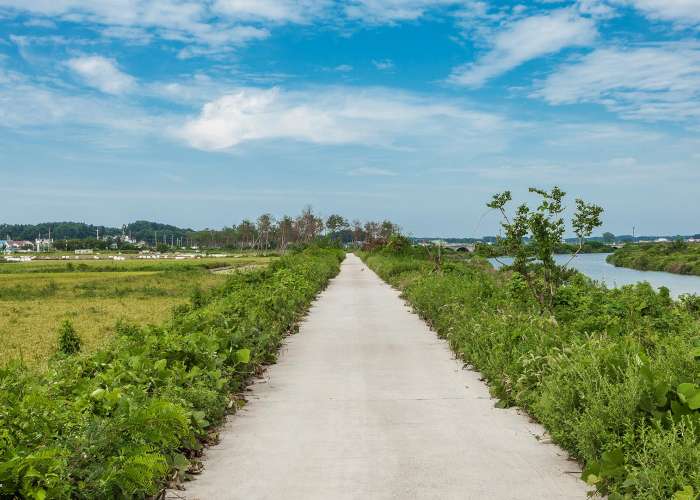
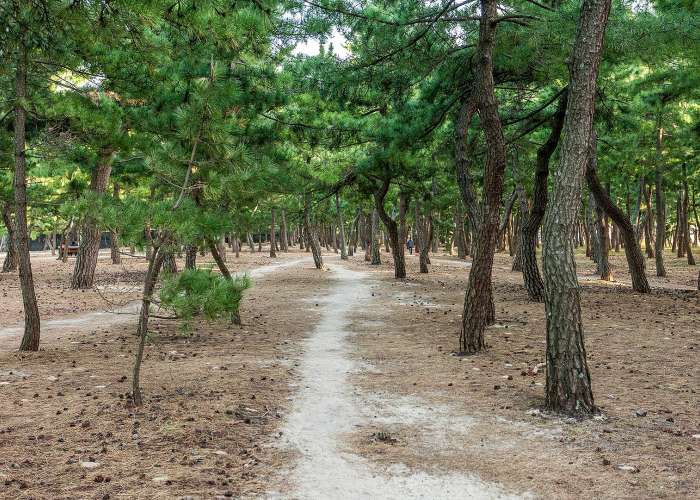
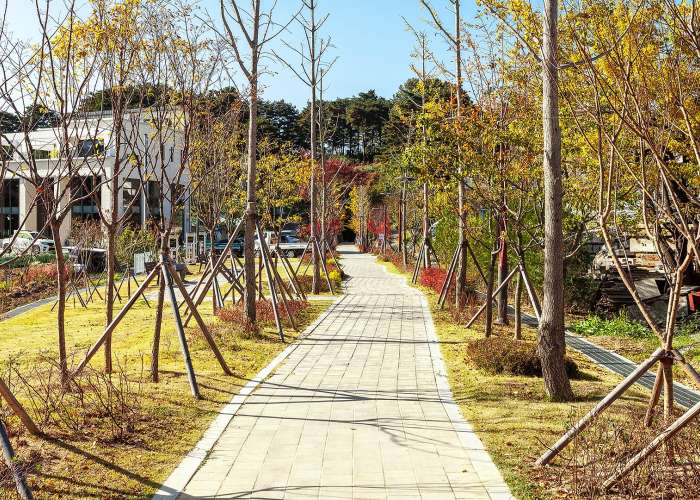
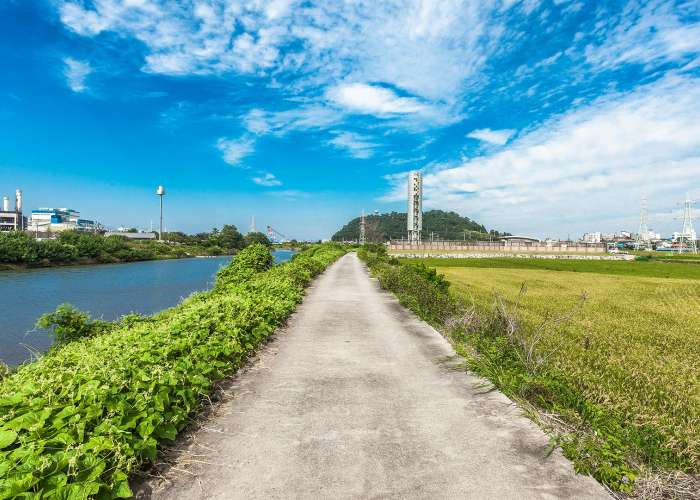
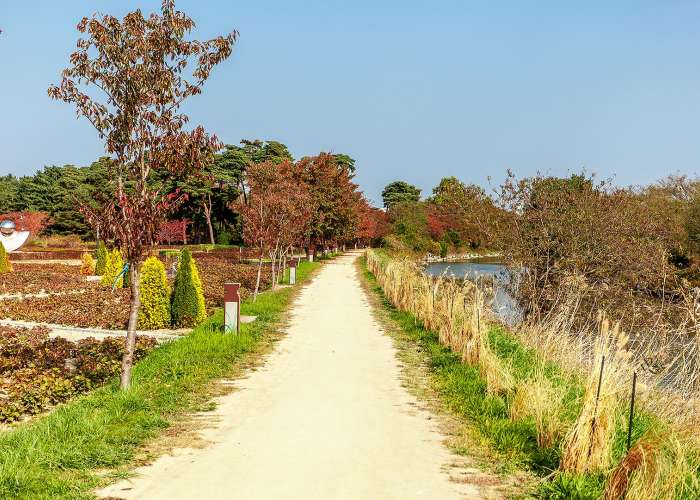
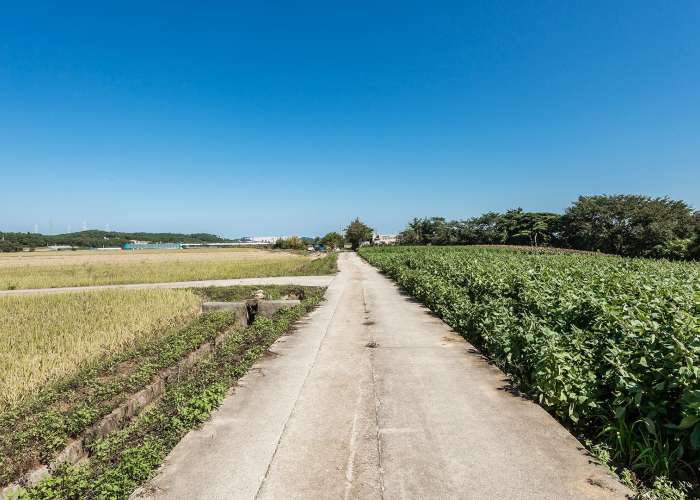
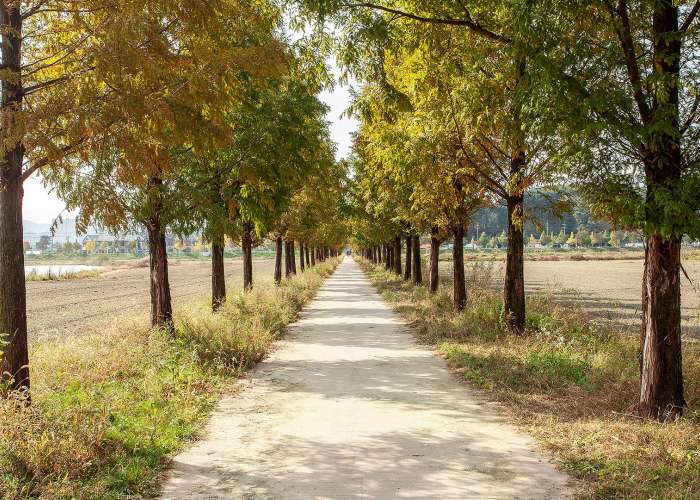
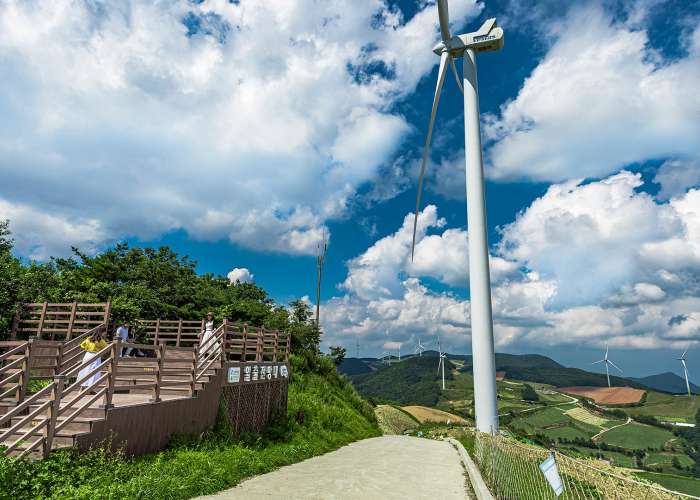
Total : 24 Latest By view 목록형 앨범형 Downtown Gangneung Bau-gil Trail Course 4 Sacheon Dukbang-gil (Sacheon Riverside Dyke Path) Introduction Bau-gil Course 4, named "Sacheon Dukbang-gil," is a scenic route that begins at the foot of the Baekdudaegan Mountain Range and leads toward the blue East Sea. The trail passes through the Kalopanax (Gaedureup) fields of Haesari Village and follows the riverside dyke. A highlight of the course is Yongyeon Valley, a cozy and quiet spot loved by vacationers. It is a unique path where you can watch salmon swimming upstream in the clear river below the wildflower-lined dyke. Tourist Guide This 18.3 km trail starts from the "Tomb of King Myeongju" and ends at "Sacheonjin-ri Beach Park." It features some of the most beautiful and quaint rural landscapes in Korea. After passing through the charming Haesari Village, the path follows 12 km of well-preserved riverside dykes. Flowers bloom in spring, lush greenery fills the summer, and in autumn, visitors can witness the rare sight of salmon returning to their birthplace. Tourist Tips Haesari Village is famous for being the top producer of Kalopanax (Gaedureup) shoots in Korea; a festival is held every April to celebrate their bitter yet refined taste. At the Sacheon Moraene Happiness Center, you can visit the "Suspicious Magic School" for performances and art experiences. Additionally, in Hapyeong Village, a traditional "Bridge Stepping" ceremony is held on the 6th day of the 2nd lunar month to pray for a good harvest. #바우길#바다#둑방#냇물#농촌#들판#꽃 Gyeongpo Area Bau-gil Course 5 Sea and Lake Path Introduction Bau-gil Course 5 is known as the Sea and Lake Path. It is a trail that follows the coast southward from Sacheon Jinri Beach, passing Gyeongpo Beach, Gyeongpo Lake, and Chodang Village, where the famous poet Heo Nanseolheon was born, and continues along the sea to Namhangjin. Not only can visitors enjoy the open, refreshing ocean view while walking, but they can also stroll along the largest pine forest path along a beach in East Asia, creating unforgettable memories. The scenic charm of Gyeongpo Lake and the adjacent pine forest along the coast enhances both beauty and nostalgia. Tourist Guide The sound of waves and seagulls from Sacheon in Gangneung signals the beginning of Bau-gil Course 5. Leaving the stone monument at the beach park behind, you walk through a pine forest path, embracing the majesty of the pine trees. Upon arriving at Gyeongpo Beach, the course circles Gyeongpo Lake. There are several attractions, including the Cham Sound Museum, Heo Gyun & Heo Nanseolheon Memorial Park, and Gyeongpo Gasiyeon Wetland, offering a variety of sights. As you stroll slowly along the lakeside and forest paths, you will eventually reach Namhangjin Beach. Travel Tips For meals, it is convenient to bring a packed lunch or use nearby restaurants. Prepare comfortable and safe trekking or hiking gear, some light snacks, and beverages. Public restrooms are available at each beach along the way. Additionally, convenience stores near the beaches make it easy to purchase simple items or drinking water, making this route very traveler-friendly. Downtown Baugil Course 6 Directions to Gulsan Temple Introduction Baugil Course 6, “The Way to Gulsansa Temple,” is a 16-kilometer long course that takes you through the old town of Gangneung. It is a course where you can experience the life, culture, and art of Gangneung, which has long been called Gangneung outside Dongdaemun. The Myeongju-dong area, centered on Daedoho Bukwan-ah, the main street of Gangneung, is full of small performance troupes and unique coffee shops, where you can experience the unique flavor of the coffee city along with the performances. Tourist guides From the starting point, Namhangjin Beach, you can't go straight south because of the airfield runway below it. So from Namhangjin Beach, you can enter Gangneung's central market and enjoy the traditional market scene and grab a bite to eat. After a long walk, pass through Gangneung Gwonsamun and Old Gwan-ah and head along the beautiful lakeside path of Janghyeon Reservoir to Haksan Village, where the largest temple in Korea, Gulsansa Temple, was located during the Silla Dynasty, and where you can see Korea's largest danganjiju (4.9 meters tall). Sightseeing tips On the third Saturday of every month, a free market is held in Myeongju-dong Alley and Guan'a, Daedoho-gu. It's worth stopping by if you have the time, as you can find everything from food to decorations. On January 1, there is a sunrise ceremony at Mosinbong. The villagers prepare rice cake soup, so it's a great way to enjoy the sunrise with Baugil. Restroom facilities are available at Namhangjin Public Restroom, Jungang Market Public Restroom, and Danoh Cultural Center. Downtown Gangneung Bau-gil Trail Course 7 Pungho Yeonga-gil (A Path of Romance and Lagoons) Introduction Gangneung Bau-gil Course 7, also known as "Pungho Yeonga-gil," features the Pungho Lagoon in Hasidong village. Like Gyeongpoho Lake, Pungho is a natural lagoon where swans visit and reeds sway in the wind. The trail offers a unique, desert-like landscape as you head toward the sea. The course starts at the "Odokttegi Training Center" (the end of Course 6) and concludes at "Anin Port." Tourist Guide This 17.7 km trail allows hikers to witness a disappearing lagoon. Once two-thirds the size of Gyeongpoho Lake, Pungho has shrunk due to industrial use, leaving only a small portion. Along the way, you can enjoy vibrant sights like poppy fields, the Jeonggami Observatory, the Jeonggami Waterside Park, and the Pungho Lotus Field. Tourist Tips Poaching or damaging wild flora and fauna is strictly prohibited. Pungho Village hosts a Lotus Festival every summer with activities like swing riding, barge (gaetbae) experiences, and traditional games. In autumn, a tea ceremony festival is held at Hansongjeong Pavilion. Since Hansongjeong is located within a military base and usually restricted, this festival is a rare opportunity for public access. #바우길#경포호수#바다#수변공원#전망대#연꽃#화랑 Downtown Gangneung Bau-gil Trail Course 8 San-ue Badat-gil (The Ocean Path Atop the Mountain) Introduction Bau-gil Course 8 spans 9.4 km from the Anin coast to Jeongdongjin. Originally named the "Security Mountain Path," it was renamed "San-ue Badat-gil" (using the local Gangwon-do dialect for "atop the mountain") to better reflect its beauty. Paradoxically, the sound of the waves is heard more clearly from the mountain peak than from the coastal road below, making hikers feel as if their feet might dip into the sea with every step. Tourist Guide Starting at the Anin Port bus stop and ending at Jeongdongjin Station, this course begins with a steep wooden staircase that feels like it reaches the sky. Walking this trail is like treading directly upon the waves. Just as one might gaze at ripples in a windy barley field, hikers can look down at the sea's furrows from the ridge, offering a perfect way to release accumulated stress. Tourist Tips Course 8 intersects with the National Security Experience Trail and Haeparang Trail Course 36. It is a popular trekking route year-round. It features a lush Geumgang Pine forest filled with a subtle pine scent and the largest oak forest in Korea. It is highly recommended for those who wish to enjoy the sound of the ocean and forest bathing (phytoncide) simultaneously. #바우길#해안#바다#정동진역#어촌#등산로#해파랑길 Jeong Dong Jin, Okgye Baugil Course 9 A Scenic Walk Along Heonhwa-ro Starting from Jeongdongjin Station Introduction Baugil Course 8, the Heonhwa-ro walking trail, stretches approximately 14 km and takes about 6 hours to complete. The route begins at Jeongdongjin Station, a famous attraction in Gangneung, and passes through Sandglass Park, Simgok Port, and Geumjin Port before ending at Okgye Market. Heonhwa-ro, which extends from Jeongdongjin, runs alongside dramatic rocky cliffs featured in the Silla-era hyangga poem “Heonhwaga.” Waves crashing over the breakwater often drench the path, creating a dynamic seaside experience. Tour Guide Starting from Jeongdongjin Station—known as the closest train station to the sea in the world—the trail loops through a village mountain path before descending along a zigzag route to the sea at Simgok. Once a deeply secluded village, so isolated that it is said residents were unaware even when the Korean War broke out, the area is now renowned for the Heonhwa-ro walking trail. Waves rolling over the breakwater soak the path leading toward Okgye Market. The trail curves gently along the coastline like the edge of a folding fan. As you walk with a loved one, you may feel inspired to pick a flower from the coastal cliffs and offer it as a romantic gesture. Travel Tips “Baugil Course 9” spans 13.9 km and takes approximately 6 hours to complete. This trekking route is steeped in the legend of Lady Suro and the Silla-era song “Heonhwaga.” The course begins at Jeongdongjin, also famous as a filming location for the drama Sandglass. Visitors who feel nostalgic about the drama are encouraged to take photos and capture their memories. The emerald-colored sea and sandy beach around Jeongdongjin Station are equally stunning. After enjoying a walk and taking photos around the station, proceed through the mountain trail entrance to reach Simgok Port. The name “Simgok” refers to a village nestled deep within a valley, and due to its remote location, it is said that residents were unaware of the outbreak of the Korean War. Crossing the Seonangdang Hill from Simgok Port reveals a breathtaking panoramic view of the East Sea, leading you onto Heonhwa-ro. This road derives its name from the story during the reign of King Seongdeok of Silla, when Lady Suro asked for azaleas blooming on a cliff; when no one volunteered, an old man herding cattle picked the flowers and sang the song “Heonhwaga.” The coastal road from Simgok Port to Geumjin Port is considered one of the most beautiful along Korea’s East Coast. As you walk, enjoy the sound of waves up close and the refreshing scent of the sea. Passing Geumjin Port and the Women’s Training Center, you will arrive at Okgye Market, the final destination of Gangneung Baugil Course 9. At Okgye Market, visitors can experience the warm hospitality and culture of the local residents. Baugil Course 9 offers a glimpse into Gangneung’s history and natural beauty. Visitors to Jeongdongjin are encouraged not only to explore the station itself but also to walk along Heonhwa-ro to fully experience the region’s culture and heritage. Downtown Bau Trail Course 11 Saimdang Trail (Cultural exploration route including Ojukheon, birthplace of Yulgok) Introduction Bau Trail Course 11, the Saimdang Trail, stretches 16.3 km, starting from Wichon-ri Village, home to Songyang Elementary School, following the waters of Jukheon Reservoir past Ojukheon, the birthplace of Yulgok, Seongyojang, one of the finest noble houses of the Joseon Dynasty, Gyeongpodae Pavilion, famous for its view of five moons, and the historical sites of the tragic genius poets Heo Gyun and Heo Nanseolheon, ending at Gangmun Jinttobaegi Village. This route is cherished for its combination of history and storytelling, offering a rich cultural exploration experience. Tourist Guide Wichon-ri Village, the starting point of this trail, boasts a 440-year-old village cooperative (Daedong-gye) preserved in its original form and is the only village in Korea still operating a traditional village chief system. It is said that when Saimdang took young Yulgok from Ojukheon to Seoul, they passed through this village along the waterway of Jukheon Reservoir and crossed Daegwallyeong. The trail is rich in historical and cultural assets, including Ojukheon (Treasure No. 165), Seongyojang House, Gyeongpodae Pavilion, and Heo Gyun & Heo Nanseolheon Historical Park, providing a diverse cultural exploration experience. Tourist Tips Wichon-ri Village, the starting point, is known for its tradition and etiquette. It has preserved the Daedong-gye system in its original form and operates the only village chief system in the nation. The village’s name originated from the story of Saimdang leading Yulgok through this village while traveling to Seoul. The trail offers insight into Gangneung’s culture and history, making it ideal for tourists interested in cultural heritage. Starting from Songyang Elementary School in Wichon-ri, the course concludes at the birthplace of Heo Gyun and Heo Nanseolheon. Course 11 has the highest concentration of cultural assets among all Bau Trail sections. Visitors can explore Ojukheon, Seongyojang, Kim Si-seup Memorial Hall, and Heo Gyun & Heo Nanseolheon Memorial Hall, making it a perfect cultural and historical walking tour with children. This trail is suitable for beginners wishing to experience Bau Trail. When directions are unclear, visitors can use the “Walking Travel Route” GPS service on smartphones. Jumunjin Area Baugil Trail Course 12 (The Road to Jumunjin – A walking path along sandy beaches and pine forests) Introduction Baugil Trail Course 12 is a 12.5 km route that begins at Sacheon Beach Park and ends at Jumunjin Port. As reflected in both its starting point and destination, this section is known as “The Road to Jumunjin.” The trail beautifully captures the everyday life of small seaside villages along the East Coast. It follows sandy beachfront paths and pine forests, passing through Yeongjin Bridge, Jumunjin Port, Jumunjin Lighthouse, and Sodol Port, before reaching the Jumunjin Beach parking area. Tourist Guide This trail runs from the beach at Sachonjin-ri to Jumunjin Port, often called the “Naples of Korea,” following sandy coastal paths and pine groves. Along the way, visitors pass Yeongjin Bohemian, widely known among coffee lovers as a “coffee pilgrimage site” in Korea, as well as the Jumunjin Lighthouse and the lively Jumunjin Market filled with the energy of the East Sea.The Jumunjin Lighthouse, rich in history and stories, invites every visitor to imagine themselves as a lighthouse keeper, illuminating the path for ships sailing across the sea.As you traverse this 12 km stretch of coastal villages, a panoramic scene unfolds before you—deep blue waters of the East Sea, seagulls over white sandy beaches, breezy forest paths filled with the scent of the sea, and the stories of the people who live alongside it. Travel Tips Along Baugil Trail Course 12, you will pass several fishing ports where you can enjoy fresh seasonal seafood throughout the year. Major ports include Jumunjin Port, Yeongjin Port, and Sacheonjin Port. The East Coast fish markets, Jumunjin Lighthouse, and Adeul Rock are iconic elements of the coastal scenery, and traditional local foods can be found at many stops along the route.As the trail follows the coastline, it offers wide-open natural landscapes—making it an ideal place to relax, unwind, and relieve everyday stress. Gyeongpo Area Baugil Course 14 Chohui-gil Introduction Baugil Course 14 is also known as Chohui-gil. It is rare to find, in any city in Korea, a forest trail that begins in the city center and leads all the way to the sea. However, Gangneung offers exactly such a path. This trail allows travelers arriving at the Gangneung Bus Terminal to cross just one traffic light and immediately enter the beautiful forest paths of Wondaejae, Bongsudae, and Chunggabong. The route continues through Chodang Village, the birthplace of Heo Nanseolheon, and extends all the way to Gyeongpo Beach. “Chohui” was the birth name of Heo Nanseolheon, and this trail is as beautiful as her name and her poetry. Tourist Guide “Chohui” was the birth name of Heo Nanseolheon, and this course is as beautiful as her name suggests. Baugil Course 14 is a forest trail that stretches from the heart of the city to the sea. The course begins at the Gangneung Bus Terminal, crosses a single traffic light, and enters the forest paths of Wondaejae, Bongsudae, and Chunggabong. It then passes through Chodang Village before reaching Gyeongpo Beach. Travel Tips The course route is: (City Hall Parking Lot) Intercity & Express Bus Terminal → Yongji Building → Wondaejae Forest Bathing Area → Gangneung Art Museum → Main Gate of Myeongryun High School → Hwabu Mountain Rest Area → Sodongsan Bongsudae → Chunggabong → Birthplace of Heo Gyun and Heo Nanseolheon → Gyeongpo Beach.The total distance is approximately 11 km and takes about 4 hours to complete. The forest trail begins immediately after crossing just one traffic light from the Gangneung Terminal. Nearby attractions include the Gangneung Municipal Art Museum, which first opened in September 2006 as Gangneung Art Museum and was reopened in April 2013 as the only municipal art museum in Gangwon State. Downtown Baugil Trail Course 15 Path to Gangneung Arboretum Introduction Baugil Trail Course 15 leads to the Gangneung Arboretum. Gangneung is known as the hometown of pine trees, which is why it is often called “Solhyang,” meaning the fragrance of pine. Unlike typical arboretums in other regions that feature artificially landscaped flower gardens, the Gangneung Solhyang Arboretum is designed as a natural forest experience and learning space centered around the native Geumgang pine trees that cover the entire mountain. Tourist Guide Starting from Seongsan Food Village, this trail is filled with the refreshing scent of pine as it passes through the Gangneung Arboretum. It continues along a path rich with a thousand years of history, passing the Three-story Stone Pagoda at Sinboksa Temple Site, originally established by the Silla-era eminent monk Beomil Guksa in Daegwallyeong. Travel Tips Course Information: Seongsan-myeon Office → Sinbuk 1-ri Village Road → Gangneung Solhyang Arboretum → Daegwallyeong Deer Ranch → Yeochan-ri Fields → Sang-a Daycare Center → Three-story Stone Pagoda at Sinboksa Temple Site → Gangneung Dano Cultural Center.Total distance is 15.5 km, and it takes approximately 6 hours to complete. Downtown Baugil Course 16 Hagisiseupji Trail Introduction Baugil Course 16 is known as the Hagisiseupji Trail. The name “Hagisiseupji” is derived from the opening phrase of Confucius’ Analects: “Is it not a pleasure to learn and to practice constantly?” This trail, explored through a collaboration between a university and a local trail organization for the first time in Korea, begins at Gangneung-Wonju National University and passes through Ojukheon House, Seongyojang House, the Memorial Hall of Kim Si-seup (Maewoldang), and the birthplace village of Heo Nanseolheon. Tour Guide This course starts at Gangneung-Wonju National University and passes by Ojukheon House, Seongyojang House, and the Heo Gyun & Heo Nanseolheon Memorial Hall. Along the way, visitors can appreciate the natural beauty of Gangneung, learn about its history, and reminisce about youthful days while passing through the university campus. The willow-lined path around Jukheon Reservoir is as picturesque as a painting, and the trail itself is like a comprehensive gift set of Korea’s classical scholar culture, encompassing the nature, history, and future of Gangneung. Travel Tips Located in Gangneung, Gangwon Province, the course route is: Gangneung-Wonju National University (Haeramji) → Jukheon Reservoir → Ojukheon House → Kim Si-seup Memorial Hall → Gyeongpo Wetland → Heo Nanseolheon Historic Site → Official Residence of the President of Gangneung-Wonju National University (Cultural History Hall). The total distance is 10.5 km, takes approximately 4 hours to complete, and is of moderate difficulty. Daegwallyeong Gangneung Bau-gil Trail Course 17 Daegwallyeong Nunkkot-maeul-gil (Snowflake Village Trail) Introduction This trail is located in Anbandegi, the nation's largest high-altitude vegetable farming complex, where the culture and history of slash-and-burn farmers are still alive. Following the 6km Oknyeobong section opened in 2015, the 14km Gorupo section was added in 2016. It offers a unique trekking experience through rural traditions and natural resources. Tourist Guide Known as the "Anbandegi Unyu-gil" (Cloud Stroll Path), it is said that even clouds stop to play here. The Oknyeobong section features a sunrise observatory, pine tree rest areas, and well-maintained trail signs. It is a place where you can feel the historical site of the slash-and-burn farmers' livelihood. Tourist Tips The Gorupo section was completed in September 2015 with eco-friendly features such as fir tree rest areas, palm mats, and safety ropes. The trail aims to provide an environmentally conscious walking experience. Visitors can enjoy the refreshing scenery of the vast vegetable fields and the serene mountain ridges. #바우길#문화#농촌#운유길#일출#왕산 1이전2