Jeongdongjin & Okgye District
- Home
- Tour
- Nature Tour
- Jeongdongjin & Okgye District
-
-
Jeong Dong Jin, Okgye
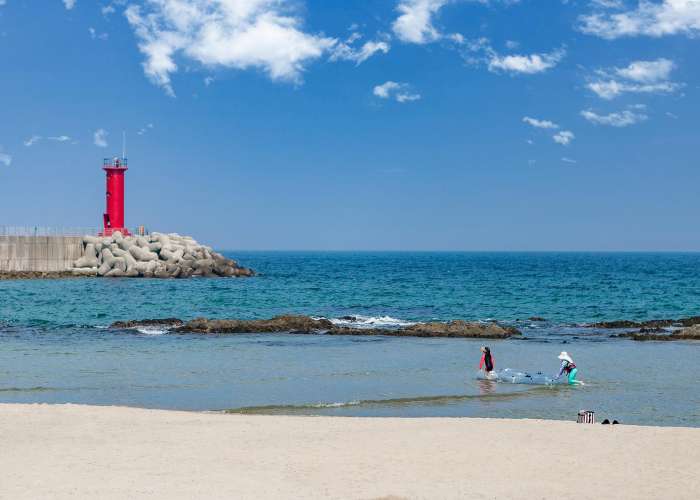
Anin Beach
A perfect summer getaway with fine sand and shallow waters
Introduction
This is where the clear waters of Gunseong River flow into the sea. The sandy beach stretches 1 km in length and 50 m in width, with a gentle slope of 10–20 degrees. The sand is fine and the water is crystal clear. Its shallow depth makes it an ideal condition for a swimming beach. Nearby attractions include Deungmyeongnakgasa Temple, Deungmyeong Beach, Gyeongpodae Pavilion, Seongyojang House, Ojukheon House, and Jeongdongjin.
Tourist Guide
Anin Beach can be reached by following National Route 7 toward Donghae and Samcheok; the beach entrance will appear on the left. It is located about 12 km from Gangneung City Hall. Although the sand is fine, there are many rocks along the shore. Visitors can enjoy catching shellfish or fishing for species such as wrasse, flounder, black porgy, and rockfish. It is also a popular destination for summer vacationers.
Travel Tips
Near Anin Beach is Aninjin Port, where visitors can enjoy sea fishing and skin scuba diving. To the south lies Unification Park, which features a Security Exhibition Hall and a Naval Vessel Exhibition Hall. There, visitors can explore the infiltration site of a North Korean submarine from 1996 and experience a security-themed hiking trail. Further south is Jeongdongjin. Close to Anin Beach is Haerangdang Shrine, where memorial rites were held for gisaeng (female entertainers). According to oral tradition, a magistrate of Gangneung once fell to his death while enjoying a swing ride with a gisaeng. Afterward, storms and poor fishing plagued the sea, prompting villagers to perform rituals. It is said that after the rites, the storms subsided and the fish returned in abundance.
-
-
Jeong Dong Jin, Okgye
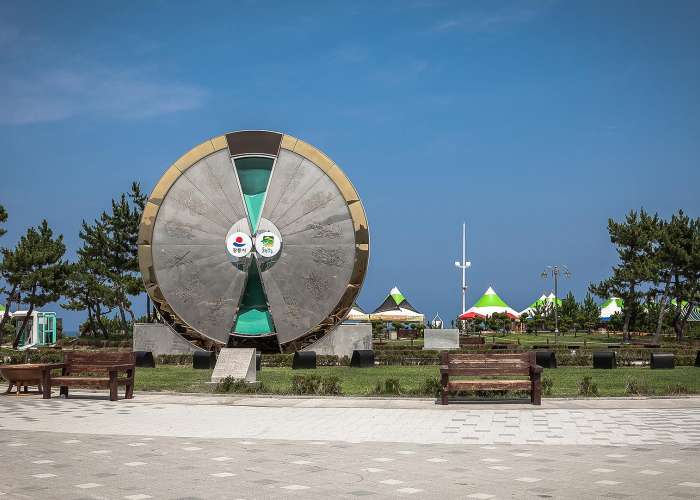
Hourglass Park
A charming park set against the backdrop of the East Sea and mountains
Introduction
Jeongdongjin Hourglass Park was created in 1999 by Gangneung City and Samsung Electronics to commemorate the new millennium, with a total project cost of 1.28 billion KRW. The hourglass inside the park is the largest in the world, measuring 8.06 meters in diameter, 3.20 meters in width, weighing 40 tons, and containing 8 tons of sand. It takes exactly one year for all the sand inside the hourglass to fall from top to bottom.
Tourist Guide
Hourglass Park was established to commemorate both the popular drama “Sandglass” and the new millennium, and features the Jeongdongjin Millennium Hourglass. Nearby attractions include Jeongdongjin Sculpture Park, Jeongdongjin Station, and Jeongdongjin Beach. There are no admission or parking fees.
Travel Tips
Hourglass Park is modestly designed with the East Sea, surrounding mountains, and Jeongdongjin 2-ri village as its backdrop. At the center stands the hourglass, surrounded by pine trees, while benches are placed facing the sea. Unlike sundials or water clocks that indicate the current time, an hourglass measures the passage of time based on the volume of sand falling due to gravity. Historically, hourglasses were made in various durations such as 4 hours, 2 hours, 1 hour, and 30 minutes, as well as 28 seconds and 14 seconds for measuring ship speed. These were widely used until the 19th century, and today, a 3-minute hourglass is commonly used for boiling eggs. It is said that the hourglass was invented around the 8th century by a French clergyman named Liutprand.The Jeongdongjin Hourglass differs from the typical narrow-waisted glass shape, as it is designed in a round form to symbolize the infinity of time. The circular shape also represents the rising sun over the East Sea, while the 32-meter-long parallel train rails symbolize the eternal flow of time. The falling and accumulating sand signifies the continuity of time rather than a separation between the past and the future.Jeongdongjin, where the hourglass stands, is located directly east of the milestone marker in front of Gwanghwamun in Seoul. It is known as one of the first places on the Korean Peninsula to see the sunrise during the summer solstice, attracting many visitors. It is highly recommended to visit with family to enjoy the beautiful sunrise and explore Hourglass Park.
-
-
Jeong Dong Jin, Okgye
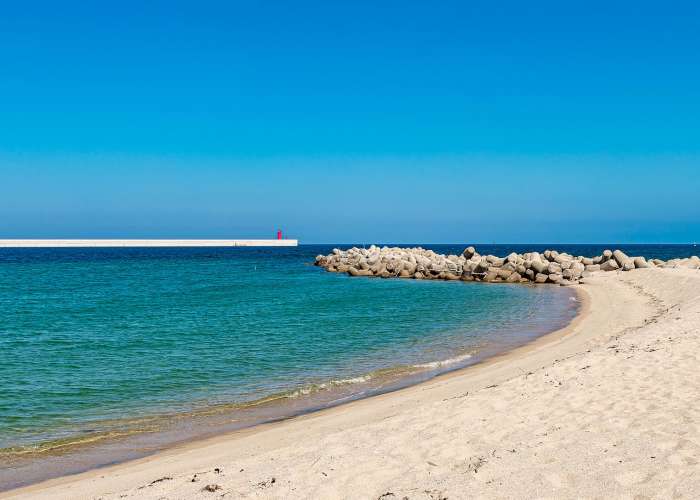
Yeomjeon Beach
A simple beach with a sandy shoreline
Introduction
Yeomjeon Beach is located in Anin-ri, Gangdong-myeon, Gangneung-si, Gangwon State. This small and quiet beach offers a relaxing retreat with emerald-colored waters. Although it is a modest-sized beach, it is equipped with convenient facilities such as showers, changing rooms, restrooms, and a campsite.
Tour Guide
Yeomjeon Beach is generally peaceful and relatively small, but it is rich in a variety of fish species, making it a popular destination for fishing enthusiasts. Visitors are encouraged to enjoy leisurely fishing throughout all four seasons, catching various types of fish. Despite its small size, the beach is well-equipped with facilities for tourists.
Travel Tips
Yeomjeon Beach is a simple beach featuring a wide sandy shore. Until the 1960s, salt fields were located beneath the Yeongdong Thermal Power Plant, and due to its proximity to Gunseon River, where seawater and freshwater meet, it has become a popular fishing spot for tourists. If you are looking for a quiet and serene natural setting to relax, Yeomjeon Beach is highly recommended.In spring, mullet migrate from the sea into freshwater, offering an exciting opportunity to catch large, arm-sized fish using casting nets. After the mullet season, schools of halfbeak begin to appear, attracting fishing enthusiasts. In winter, black porgy season provides another enjoyable fishing experience. In addition to seasonal catches, a wide variety of fish such as wrasse and flounder can be found throughout the year, with marine worms commonly used as bait.Besides fishing, tying leftover pork belly or meat heads to a line and catching small crabs hiding in rock crevices can create unique and memorable experiences. Around Yeomjeon Beach, you can also see numerous flounder fish farms.Between Jeongdongjin Station and Yeomjeon Beach, there is a scenic walking route with beautiful ocean views, perfect for a leisurely stroll and relaxation.In Gangneung, Jang Kalguksu (spicy noodle soup) is a local specialty. There are well-known restaurants near Yeomjeon Beach, so visitors are encouraged to enjoy a bowl after spending time at the beach. Additionally, many seafood restaurants nearby offer fresh raw fish, making it a great place to savor the flavors of the East Sea.
-
-
Jeong Dong Jin, Okgye
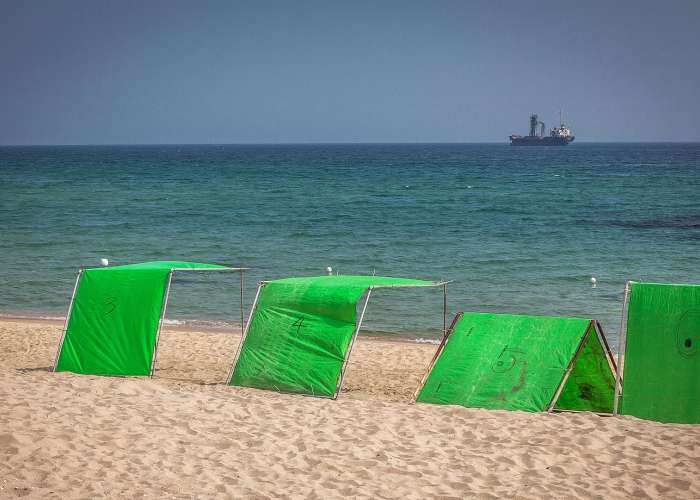
Dojik Beach
A 500-meter-long simple beach located at the southernmost end of Gangneung City
Introduction
Dojik Beach is a simple beach located in Dojik-ri, Okgye-myeon, at the southernmost part of Gangneung City. It stretches 500 meters in length and covers an area of 50,000㎡. The name “Dojik” comes from the word meaning “straight,” referring to the straight layout of the village. With the construction of the Donghae Expressway, the village was divided into two parts, and residents relocated as a group, leaving the original village no longer in existence. True to its name, this is a rare place where five transportation routes—national highway, railway, expressway, airway, and sea route—run parallel to each other.
Tour Guide
Dojik Beach is known for its clean sand and spacious parking area, making it a მშვიდ and popular destination for families. For accommodation, visitors can use local guesthouses. The beach features a simple parking lot of approximately 3,000㎡ and a campsite of about 1,000㎡ that can accommodate around 66 tents.Around Dojik Beach, fish such as wrasse, rockfish, and flounder are caught throughout the year. On weekends, it is common to see families enjoying fishing together, often using marine worms as bait. Four fishing boats operate year-round, harvesting octopus and clams. In spring, filefish and olive flounder are mainly caught, while in autumn, yellowtail and gizzard shad are the primary catch. Boats usually return to port around 2–3 PM.Seaweed (March–May), sea squirts (year-round), sea cucumbers (December–March), sea urchins (December–May), jinuwari seaweed (spring), hijiki (February–May), and laver (January–March) are also harvested, with returns to port around 1 PM.
Travel Tips
Located next to the well-known Mangsang Beach, Dojik Beach is the southernmost beach in Gangneung. Although not widely known, it is a place that quickly captures visitors’ hearts once experienced. Situated between Okgye Service Area and Donghae Service Area, the beach lies along the Yeongdong Line railway and the Donghae Expressway (Route 65), and can also be accessed via National Route 7 from Gangneung.As it is within a military zone, the beach is open only during the peak summer season. It offers a quiet and clean environment. To find accommodations, it is easier to cross the railway and expressway into Dojik-ri. The presence of barbed-wire fences creates a solemn atmosphere and can evoke a sense of the division of Korea.Recently, there have been efforts to build modern pensions, but there is a hope that accommodations reflecting the local character of Dojik-ri will be preserved rather than overly urbanized styles. Instead of uniform beaches, it is desirable to maintain the unique identity of each region.Although the sandy beach is not very wide, there is a campsite available. It includes shower facilities, and the ground is natural soil. Camping is available for approximately 10,000 KRW per night. This beach is ideal for campers seeking a quiet environment, but the campsite is not operated during winter due to freezing issues with water facilities.Like other beaches, Dojik Beach operates during July and August, and there is no entrance fee. While many visitors come to enjoy swimming, it is also popular among anglers targeting wrasse.After enjoying the beach, cross the road and explore Dojik-ri village. Although the original village disappeared due to the expressway, relocated residents have settled across the beach. The village still retains the appearance of a traditional fishing community, including a Seonangdang shrine located on the hillside near the expressway. This wooden shrine hosts annual rituals.While such rituals may seem like stories of the past to outsiders, for local residents whose livelihood depends on fishing, they represent earnest wishes for safety, prosperity, and abundant catches. Observing the shrine, one cannot help but hope that these local traditions will not disappear under commercial development.Nearby attractions include Neulhaetsal Rural Experience Village (Manwoo Village), Daejin Village, and Mukho Port. Other nearby camping sites include Donghae Mangsang Auto Camping Site, Okgye Beach, and Nobong Auto Campground.
-
-
Jeong Dong Jin, Okgye
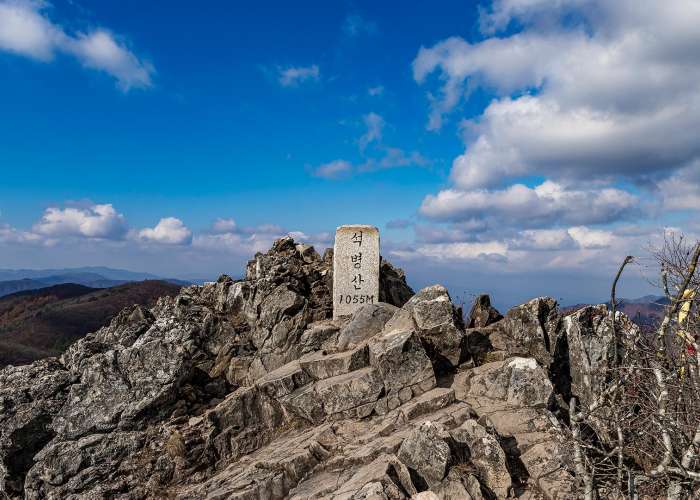
Seokbyeongsan Mountain
A mountain spanning Imgye-myeon in Jeongseon-gun and Okgye-myeon in Gangneung-si, Gangwon Special Self-Governing Province
Introduction
Seokbyeongsan Mountain is located on the boundary between Sanggyeri in Okgye-myeon, Gangneung-si, and Jigwon-ri in Imgye-myeon, Jeongseon-gun, Gangwon Special Self-Governing Province. It lies along the Taebaek Mountain Range. To the north of Seokbyeongsan is Duribong Peak, while to the south lie Jabyeongsan Mountain and Baekbokryeong Pass. The southern area of Seokbyeongsan features karst topography, with nearby attractions such as Seokhwa Cave, stone caves, and a cement quarry.
Tourist Guide
Seokbyeongsan Mountain, spanning Imgye-myeon in Jeongseon-gun and Okgye-myeon in Gangneung-si, boasts a height of 1,055 meters. The mountain is characterized by unique rock cliffs that resemble folding screens and its grand scale. Formed primarily of gypsum rock, it contains numerous caves, and although Beombawigol Valley is the main valley, no water flows through it. Additionally, when ascending along Jeongeori Valley, visitors will find a wide field and a spring where water emerges. The summit of Seokbyeongsan consists of two white rock peaks; the northern side forms a sheer cliff, and the rock ridge extends toward the northeast.
Travel Tips
The magnificent rock formations and natural scenery of Seokbyeongsan attract many visitors. For those who wish to hike the mountain using a relatively easy course, it is recommended to start from Baekbongnyeong Pass, pass through Seokbyeongsan, and continue to Sapdapnyeong Pass. At Baekbongnyeong and the ridge near Peak 834, there is space large enough to accommodate several large buses. However, Sapdangnyeong Pass can barely accommodate one large bus, so please plan your route carefully. Visitors can enjoy refreshing mountain breezes at Seokbyeongsan, and the summit is composed of three modest-sized rock peaks. Beneath the central peak is a rock cave that has been blocked with stones due to candles lit for ritual prayers. Throughout both the ascent and descent, hikers can enjoy beautiful wildflowers and azaleas. However, since the area is less frequented by hikers, extra caution is required during summer as you may need to pass through vine-covered areas and thorny vegetation. Also, if you continue heading north after reaching the triangulation point on Seokbyeongsan, you may deviate from the main ridge trail. Therefore, to reach Duribong Peak, you must return to the triangulation point and follow the signs heading west.